
Your Competitors Are Ranking for These Keywords. Are You?
 Sachin Gupta19 Nov 2026
Learn how to find keywords your competitors rank for using Ahrefs, Semrush and free tools. Identify keyword gaps, analyse search intent and uncover new SEO opportunities for your website.
Summarize this article with AIFinding the right keywords for your website can be challenging, especially when you are entering a competitive industry. You may know what your audience is searching for, but are you targeting the same opportunities that are already bringing traffic to competing websites?
One way to find out is through competitor keyword research.
By analysing the keywords your competitors rank for, you can discover new search terms, understand what your audience wants to know, identify content gaps and improve your existing SEO strategy.
To find keywords your competitors are ranking for, enter their website domain into an SEO tool such as Ahrefs or Semrush. Open the Organic Keywords report to see their ranking search terms, positions and estimated traffic. Then compare those keywords with your own website to identify relevant opportunities.
In this guide, we will explain how to find competitor keywords using free and paid tools, perform keyword gap analysis, evaluate search intent and use your findings to create better website content.
What Are Competitor Keywords in SEO?
Competitor keywords are the search terms for which other websites appear in search engine results.
These keywords may bring visitors to a competitor's homepage, service pages, product pages or blog articles.
For example, imagine you run a digital marketing agency in Delhi. Your SEO competitors might rank for searches such as:
- Digital Marketing Agency in Delhi
- Digital Marketing Company in Delhi
- SEO Services in Delhi
- Local SEO Services
- Website Development Company in Delhi
- How to Improve Website Rankings on Google
By studying these search terms, you can understand which topics your competitors cover and identify relevant keywords that your own website may be missing.
However, competitor research does not mean copying another website's keyword list. It means understanding what is working in your industry and finding opportunities that make sense for your business.
Why Is Competitor Keyword Research Important?
Competitor keyword research helps you understand the search landscape before deciding what content to create or improve.
Here are five ways it can support your SEO strategy.
1. Discover Keywords You Have Missed
Your competitors may rank for search terms that you have not considered. These keywords can reveal new topics, customer questions and service-related searches worth targeting.
2. Understand Your Audience's Search Behaviour
The keywords competitors rank for can provide clues about what people want to learn, compare or purchase.
For example, searches such as "best SEO company in Delhi" suggest that someone may be comparing service providers before making a decision.
3. Find Content Gaps
You may already have articles about SEO, website development or digital marketing. However, competitors might cover related questions that your website has not addressed.
Identifying these gaps helps you decide where additional content could be useful.
4. Improve Existing Website Pages
Competitor research can reveal related search terms that your existing pages may not cover properly.
Instead of publishing another article on the same subject, you can improve an existing page with better explanations, examples and relevant information.
5. Build a More Focused SEO Strategy
You can use competitor keyword data to prioritise topics based on search intent, relevance, competition and business value.
This helps you spend time creating content that attracts the right audience rather than targeting keywords simply because they have high search volume.
How to Find Keywords Your Competitors Are Ranking For
You can use SEO platforms, Google search results and your own website data to research competitor keywords.
Let's look at the process step by step.
Step 1: Identify Your Actual SEO Competitors
Before analysing keywords, you need to identify the websites competing with yours in search results.
Your business competitors and SEO competitors are not always the same.
For example, a digital marketing agency may compete with another agency for clients. But in Google search results, it may also compete with marketing blogs, industry websites and specialist SEO companies.
To find your SEO competitors:
- Open Google Search.
- Search for your main target keywords.
- Check the websites appearing on the first page.
- Look for websites that repeatedly appear for related search terms.
- Select three to five relevant competitors for your initial research.
For example, a Delhi-based digital marketing agency can search for:
- Digital Marketing Agency in Delhi
- SEO Company in Delhi
- Digital Marketing Services in Delhi
- Local SEO Services in Delhi
Make a list of websites that consistently appear in these search results.
Important: Do not select competitors based only on their business size or popularity. Choose websites that compete for the same search terms and target a similar audience.
Step 2: Find Competitor Keywords Using Ahrefs
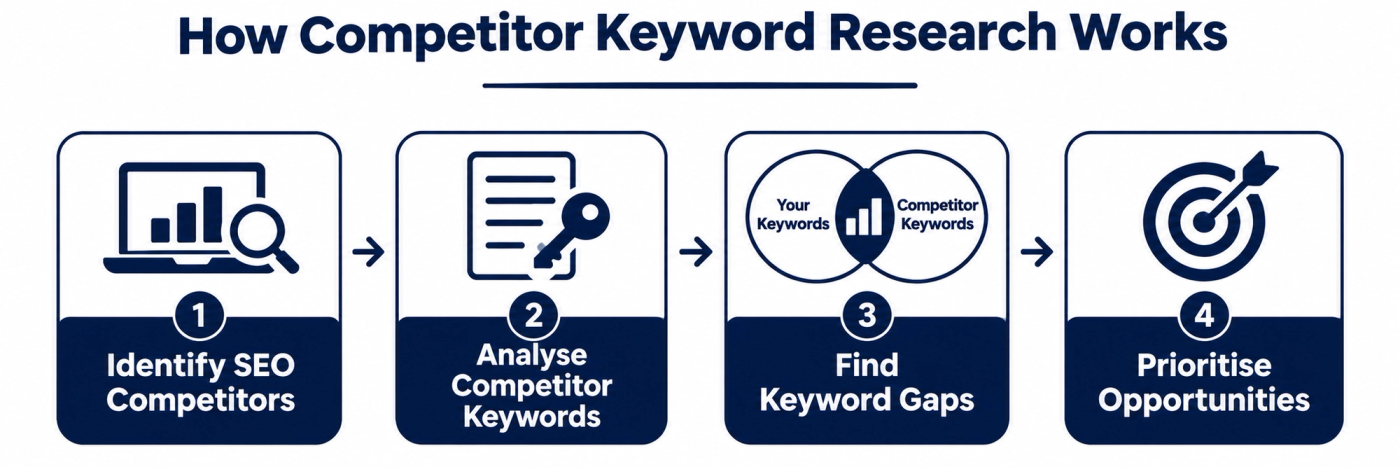
Four-step competitor keyword research process.
Ahrefs is an SEO research platform that helps you analyse organic keywords, backlinks, ranking pages and competitor performance.
Its Site Explorer feature allows you to investigate the search terms for which a website ranks.
How to use Ahrefs:
- Open Ahrefs Site Explorer.
- Enter your competitor's website domain.
- Select the Organic Keywords report.
- Review the keywords listed for that website.
- Check their ranking positions, estimated traffic and keyword difficulty.
- Apply filters to find keywords relevant to your business.
- Export the data for further analysis.
You can also use the Top Pages report to identify which competitor pages receive the most estimated organic traffic.
For example, suppose a competing agency has a page ranking for "Local SEO Services in Delhi".
Instead of noting only the keyword, open the ranking page and examine:
- What services does the page explain?
- Which related keywords does it cover?
- What questions does it answer?
- Is it a service page or an informational article?
- Does it provide useful examples?
This helps you understand why the page may be relevant to that search.
Step 3: Analyse Competitor Keywords Using Semrush
Semrush is another widely used SEO platform for researching organic rankings and identifying keyword opportunities.
Its Organic Research and Keyword Gap tools are particularly useful for competitor analysis.
How to use Semrush:
- Open Semrush.
- Enter your competitor's domain.
- Navigate to Organic Research.
- Open the Positions report.
- Review the keywords and their ranking positions.
- Check the page's ranking for those terms.
- Open Keyword Gap to compare your website with competitor domains.
- Review the Missing and other keyword opportunity categories.
The Missing keyword filter is especially useful because it identifies keywords for which your selected competitors rank but your website does not.
Example:
Suppose your website targets "Digital Marketing Agency in Delhi", but your competitors also rank for:
- SEO Services for Small Businesses
- Google Business Profile Optimization
- Local SEO Company in Delhi
- Website SEO Audit Services
These terms may represent opportunities worth investigating.
Before creating new content, check whether each keyword is relevant to your services and whether your website already has a page that could target it.
Step 4: Find Competitor Keyword Ideas Using Google
You do not always need a paid SEO tool to begin competitor keyword research.
Google itself can help you understand the topics and questions people search for.
Start by entering your main keywords into Google and observing the results.
Pay attention to:
Google Autocomplete: Suggestions that appear while typing can reveal related search queries.
People Also Ask: These questions can help you understand what additional information searchers may need.
Related Searches: The suggestions near the bottom of the results page can provide more keyword ideas.
Competitor Page Titles: These can reveal the topics and search intent that competing pages address.
For example, searching for "How to improve website SEO" may reveal related questions about website speed, technical SEO, content quality and keyword placement.
You can use these ideas to expand your keyword research.
However, Google search suggestions do not show a competitor's complete ranking keyword list. They are useful for discovering search topics and understanding user questions.
Step 5: Use Google Keyword Planner for More Keyword Ideas
Google Keyword Planner is a free keyword research tool available through Google Ads.
Although it is designed for advertising campaigns, it can also help you discover related keywords and understand estimated search demand.
How to use Google Keyword Planner:
- Open Google Ads and access Keyword Planner.
- Select Discover New Keywords.
- Choose the option to start with a website.
- Enter a competitor's website URL.
- Review the suggested keywords.
- Note relevant search terms and estimated search volume ranges.
- Add useful ideas to your keyword research sheet.
For example, entering a digital marketing agency's website may generate related keyword ideas around SEO, social media marketing, website development and online advertising.
Keep in mind that Keyword Planner does not provide a complete report of a competitor's organic rankings. Use it to discover keyword ideas and search demand rather than to verify their exact Google positions.
What Is Keyword Gap Analysis?
Keyword gap analysis is the process of comparing your website's ranking keywords with those of your competitors to identify search terms they rank for but your website does not.
It helps you find missing topics and opportunities to improve your website's search visibility.
For example, imagine your website ranks for:
- Digital Marketing Agency in Delhi
- SEO Company in Delhi
- Website Development Services
But your competitors also rank for:
- Local SEO Services in Delhi
- Google Business Profile Optimization
- SEO Services for Small Businesses
- Website SEO Audit Services
These additional keywords could represent content gaps.
However, a keyword gap is not automatically a content opportunity. You should first check whether the keyword matches your business, audience and website goals.
How to Perform Keyword Gap Analysis
1. Collect keyword data
Export relevant organic keywords from your competitors using Ahrefs or Semrush. Collect your own website's query data from Google Search Console.
2. Compare the keyword lists
Identify keywords where competitors rank but your website does not. Also note keywords where your website ranks lower than competing pages.
3. Remove irrelevant search terms
Remove competitor brand names, unrelated topics and keywords that do not match your products or services.
4. Check the search results
Search each important keyword on Google. Review the pages appearing in the results and understand the type of content searchers expect.
5. Prioritise the opportunities
Group relevant keywords according to their search intent, business value and ranking potential.
Example of Competitor Keyword Gap Analysis
The following is an illustrative example for a digital marketing agency. These ranking positions are sample values, not actual competitor data.
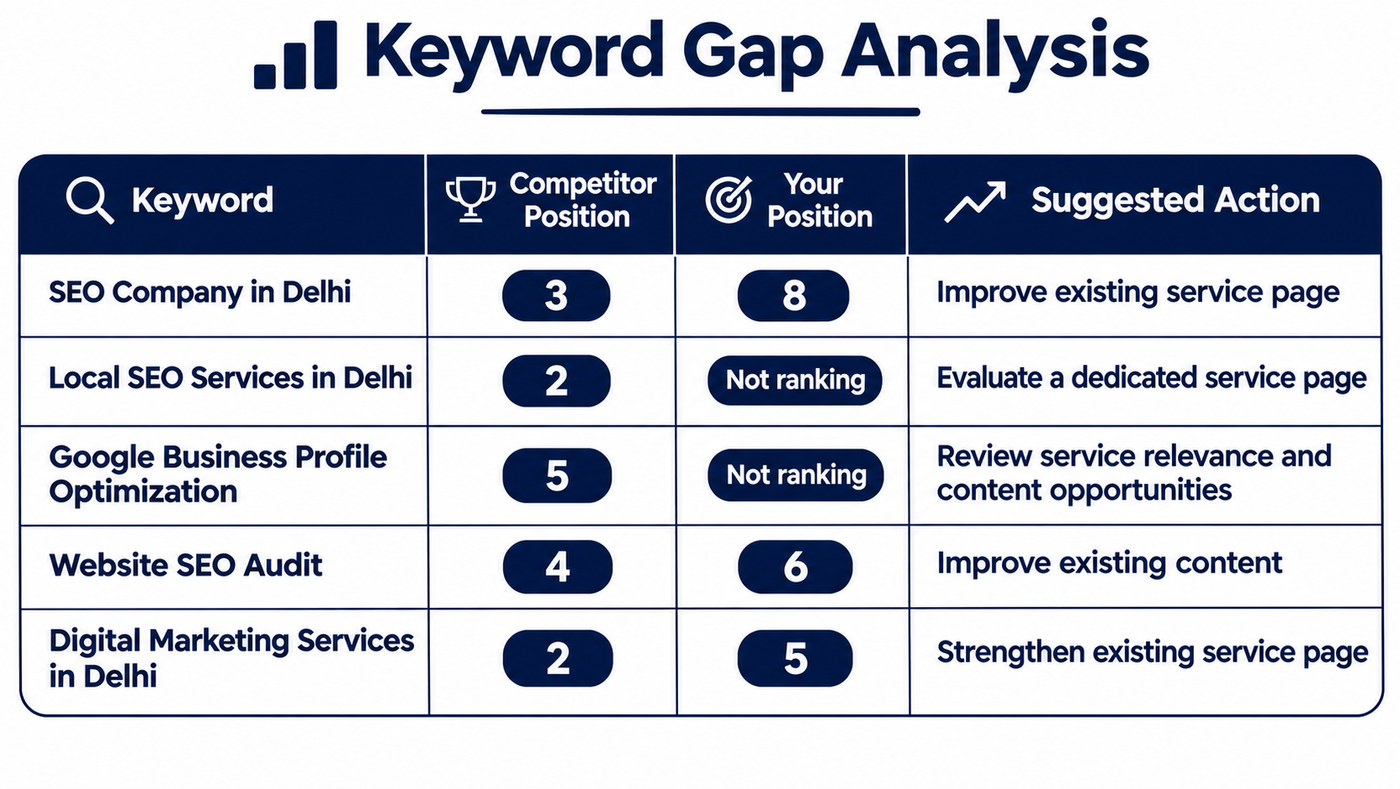
Keyword gap analysis comparing competitor rankings, your website positions and suggested SEO actions for five Delhi-focused keywords.
This type of comparison makes it easier to identify where your website already has visibility and where additional work may be needed.
How to Choose the Right Competitor Keywords
After collecting competitor keywords, the next step is deciding which ones deserve attention.
A keyword with high search volume is not necessarily the best choice for your website.
Evaluate these five factors before adding a keyword to your SEO strategy.
1. Search Volume
Search volume estimates how often people search for a particular keyword during a given period.
It can help you understand search demand, but it does not guarantee traffic or conversions.
A keyword with lower search volume may still be valuable if it attracts people looking for a service your business provides.
2. Keyword Difficulty
Keyword Difficulty is an SEO tool's estimate of how challenging it may be to rank for a particular keyword.
It can help you compare keyword opportunities, but it is not a direct Google ranking factor.
Review the actual search results, competing pages and content quality before deciding whether to target a keyword.
3. Search Intent
Search intent refers to the reason behind a user's search.
There are four commonly used search intent categories:
- Informational: The user wants to learn something. Example: "What is competitor keyword research?"
- Navigational: The user wants to find a particular website or brand. Example: "Ahrefs login."
- Commercial: The user is comparing products or services. Example: "Best SEO company in Delhi."
- Transactional: The user is ready to take an action. Example: "Hire an SEO agency in Delhi."
Understanding search intent helps you decide whether a keyword belongs on a blog article, service page or another type of landing page.
4. Business Relevance
Ask yourself whether the keyword relates to your actual products, services or expertise.
For example, a digital marketing agency may find a keyword about mobile phone reviews with high search volume. However, unless the agency offers relevant content or services around that subject, targeting it may not bring meaningful business value.
5. Ranking Potential
Look at the websites already ranking for the keyword.
Check:
- Are the ranking pages relevant to the search?
- Are they detailed and useful?
- Do they provide original information?
- What type of content does Google display?
- Can your website create something more useful for that audience?
Use these observations to decide whether the keyword is worth targeting.
How to Turn Competitor Keywords into a Content Strategy
Finding keywords is only the beginning. The real value comes from using those insights to improve your website.
There are three practical ways to use competitor keyword research.
1. Create Content for Missing Topics
If competitors rank for a relevant topic and your website does not cover it, consider creating a new article or service page.
For a digital marketing agency, potential topics might include:
- How to Improve Local SEO for Small Businesses
- What Is a Google Business Profile?
- Why Is Your Website Getting Traffic but No Leads?
- How to Find the Right Keywords for Your Website
- What Is Technical SEO and Why Does It Matter?
Choose the content format according to search intent. Informational searches generally need helpful articles, while service-related searches may need dedicated landing pages.
2. Improve Existing Website Content
Sometimes, your website already covers a topic, but the page does not answer all the relevant questions.
Compare your page with the pages ranking for the same keyword.
Look for missing explanations, unclear headings, outdated information and questions that your competitors answer more effectively.
You can improve:
- Page titles and meta descriptions
- Main headings and subheadings
- Explanations and practical examples
- Internal links to relevant pages
- Image descriptions and alt text
- Frequently asked questions
The goal is to make the page more useful, not simply longer.
3. Build Topic Clusters
A topic cluster connects one main subject with several related articles.
For example, if your main subject is SEO services, supporting articles could cover:
- What Is Technical SEO?
- How Does Local SEO Work?
- How to Find Keywords Your Competitors Are Ranking For
- What Is Keyword Difficulty?
- How to Perform a Website SEO Audit
Connect these articles with relevant internal links and link to the main service page where it makes sense.
This creates a more organised website structure and helps visitors move between related topics.
How Competitor Keyword Research Helps with AEO
Answer Engine Optimization (AEO) focuses on making website content useful and easy to understand for answer-focused search experiences.
Competitor keyword research can help you identify the questions people are asking and the information existing pages may be missing.
For example, if people search for "How can I find my competitor's keywords?", your article should answer that question clearly rather than making readers go through several unrelated paragraphs.
To make your content more answer-friendly:
- Use clear, question-based headings.
- Provide direct answers near the beginning of relevant sections.
- Explain technical terms in simple language.
- Include practical examples and useful steps.
- Add FAQs that address genuine search questions.
- Keep information accurate and consistent.
A clear answer structure can improve usability and make the information easier for search systems to interpret. However, FAQ sections do not guarantee featured snippets or special search visibility.
How to Optimise Competitor Keyword Content for GEO
Generative Engine Optimization (GEO) is an approach to improving how clearly your brand and website content can be understood and represented in generative AI search experiences.
For GEO, publishing content around a keyword is not enough. Your article should provide useful information, clear explanations and evidence of genuine expertise.
Here are some ways to strengthen your content:
1. Provide original information
Do not simply rewrite what other websites have already published. Add your own observations, examples, research and practical explanations.
2. Explain topics with clear context
If you mention keyword difficulty, explain what it means and how it should be interpreted. Avoid unexplained technical terms.
3. Support factual statements
Use reliable sources when discussing tools, industry developments, statistics or technical information.
4. Make your business expertise clear
Clearly explain what your company does, which services it provides and which topics it has experience with.
5. Keep information consistent
Maintain accurate business details, service descriptions and brand information across your website and other relevant online profiles.
6. Answer related questions naturally
Cover the important questions around a topic instead of repeating the same keyword throughout the article.
There is no guaranteed formula for appearing in AI-generated answers. GEO should focus on making content useful, accurate, original and easy to understand.
Common Mistakes to Avoid During Competitor Keyword Research
Competitor research can produce hundreds or even thousands of keyword suggestions. But collecting a large list does not automatically improve your SEO performance.
Avoid these common mistakes:
Targeting every competitor keyword: Some search terms may be unrelated to your services. Choose keywords that match your audience and business.
Ignoring search intent: A blog article may not be the right format for a keyword where Google mainly displays service pages. Always check the search results.
Focusing only on search volume: High-volume keywords may be highly competitive or attract visitors who are not interested in your services.
Copying competitor content: Use competitor pages to identify gaps and understand topics. Create original content instead of copying their wording or structure.
Publishing multiple pages for the same search intent: Similar pages can compete with one another. Group related keywords and decide whether one useful page can cover them.
Ignoring existing website content: Before creating a new article, check whether an existing page can be improved to target the opportunity.
Treating SEO tool data as exact: Third-party tools provide estimates. Validate important keyword opportunities using your own Google Search Console data and current search results.
How Often Should You Check Competitor Keywords?
For many small and growing businesses, a monthly competitor keyword review is a practical starting point.
During this review, check:
- Which new keywords competitors are ranking for.
- Whether important competitor pages have gained or lost visibility.
- Which relevant keyword gaps remain.
- How your own keyword positions are changing.
- Whether existing content needs improvement.
You can also review competitor keywords when launching a new service, entering a new market or planning a new content category.
Regular research helps you understand changes in your search landscape and adjust your content priorities.
Frequently Asked Questions About Competitor Keyword Research
1. How can I find keywords my competitors are ranking for?
Enter your competitor's website domain into an SEO tool such as Ahrefs or Semrush. Open its Organic Keywords or Organic Research report to see ranking search terms, estimated positions and the pages associated with those keywords.
2. Can I find competitor keywords for free?
Yes. Google Search, Google Autocomplete, People Also Ask and Google Keyword Planner can help you discover related search terms and content ideas. However, these tools do not provide a complete list of a competitor's organic rankings.
3. Which tool is best for competitor keyword research?
Ahrefs and Semrush are popular options for competitor keyword analysis. Both provide organic keyword research and keyword gap features. Your choice depends on your budget, research requirements and preferred workflow.
4. What is keyword gap analysis in SEO?
Keyword gap analysis compares your website's keyword rankings with those of your competitors. It helps identify relevant search terms for which competitors rank but your website does not.
5. Should I target every keyword my competitors rank for?
No. Choose keywords according to their relevance, search intent, business value and ranking potential. Targeting unrelated keywords may bring visitors who are unlikely to need your services.
6. How do I know whether a competitor keyword is worth targeting?
Check its search intent, estimated search volume, keyword difficulty, ranking pages and relevance to your business. A keyword is worth considering when it matches your audience's needs and offers a realistic content opportunity.
7. Can Google Search Console show my competitors' keywords?
No. Google Search Console provides performance data for your own verified website, including queries, clicks, impressions and average positions. It does not reveal the complete organic keyword rankings of competing websites.
You can compare your Search Console data with competitor research from SEO tools to identify keyword gaps.
8. What should I do after finding competitor keywords?
Group related keywords according to their topic and search intent. Then decide whether to create a new page, improve an existing page or add useful supporting information. Track your website's performance through Google Search Console and analytics tools.
9. How many competitors should I analyse for keyword research?
Start with three to five relevant SEO competitors. This is usually enough to identify common ranking keywords and useful content gaps. You can expand your research as your website and SEO strategy grow.
Final Thoughts
Finding keywords your competitors are ranking for can give you a clearer understanding of your industry's search landscape. It helps you identify missed topics, understand what your audience is searching for and find opportunities to improve your website.
But the purpose of competitor keyword research is not to copy another website's rankings. It is to understand why certain pages appear in search results and identify how your own website can provide something more useful.
At Digivanta, we believe effective SEO starts with understanding what people are searching for. By combining competitor research, search intent analysis and useful website content, businesses can build a more focused approach to improving their search visibility.