
Why Does the Price Increase at Checkout? Hidden Fees Explained
 Sachin Gupta19 Oct 2026
Why does your online shopping bill increase at checkout? Understand delivery fees, convenience charges, drip pricing, and how transparent pricing builds customer trust.
Summarize this article with AI
You find a product online for ₹499. You add it to your cart, move to checkout, and suddenly the total becomes ₹579.
Where did the extra ₹80 come from?
It might be a delivery fee, platform charge, handling fee, convenience fee, or an optional add-on you did not notice. The same experience can happen when ordering food, booking movie tickets, or reserving a hotel online.
The frustrating part is not always the extra cost itself. It is discovering that cost after you have already decided to buy.
So, why does the price increase at checkout? The answer depends on how the business calculates its final price, when it reveals additional charges, and how the checkout experience is designed.
Let's break it down.
Why Does the Price Increase at Checkout?
The price shown on a product page may not include every charge associated with completing the purchase.
For example, an online order might look like this:
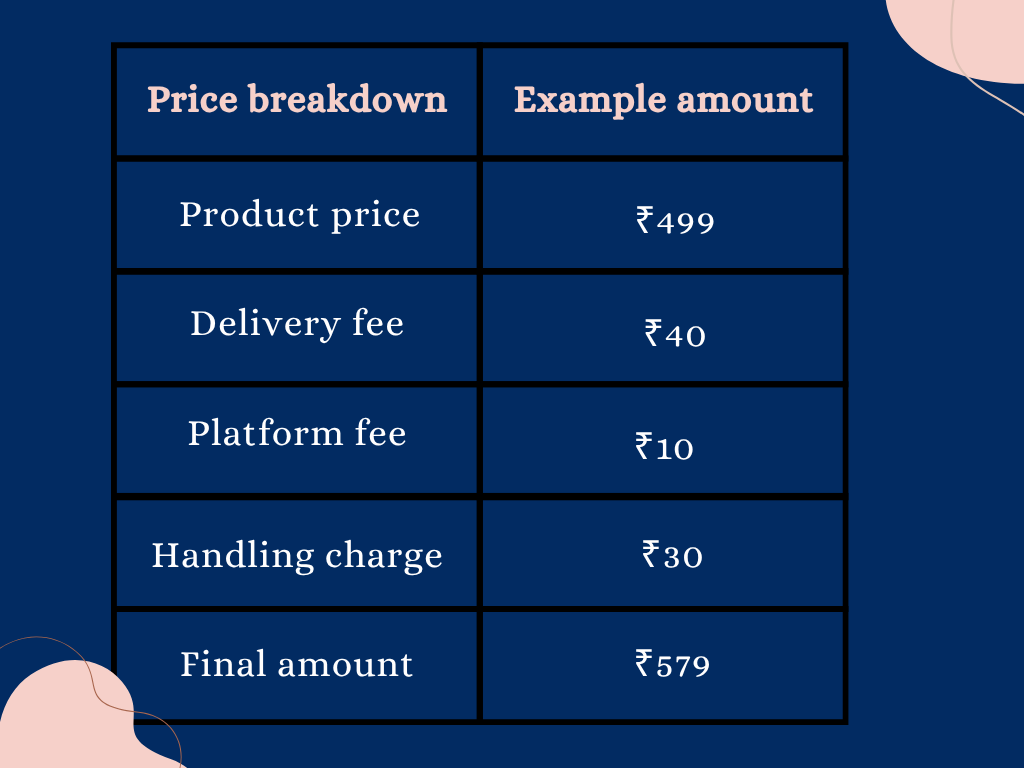
This is an illustrative example, not the pricing of a specific company.
Each additional charge may have a different purpose. Delivery fees can cover shipping, while platform or convenience fees may help cover the costs of operating a service or processing a booking.
The important question is whether the charges are explained clearly and early enough for customers to make an informed decision.
When the initial price attracts attention but the actual payable amount appears much later, customers can feel misled—even if the additional fees are individually small.
5 Reasons Your Final Bill May Be Higher
1. Delivery and handling charges
Some businesses display the product price separately from delivery or handling costs.
A product may appear cheaper than a competitor's offering until you add shipping charges. This is why comparing only the displayed product price can give you an incomplete picture.
The more useful comparison is the final amount you would actually pay for the same product, delivery option, and quantity.
2. Platform and convenience fees
Food delivery apps, ticket-booking platforms, and other digital services may add platform or convenience fees.
These charges can be small enough to overlook individually. But if you use a service frequently, the additional amount can become noticeable over time.
A convenience fee is not automatically a hidden charge or an unfair practice. What matters is how it is disclosed, whether the charge is applicable to the transaction, and whether the customer can understand the total before paying.
3. Taxes and other applicable charges
Taxes or other applicable charges may also affect the final bill, depending on the product, service, and how the displayed price is structured.
A difference between the initial and final price is not automatically evidence of misleading behaviour. The customer needs to be able to understand what the original price includes and why the total has changed.
Clear price breakdowns help avoid confusion.
4. Optional add-ons selected during checkout
Some checkout pages offer extras such as faster delivery, additional protection, donations, or other paid services.
These options are not necessarily problematic when customers can understand the offer and make a genuine choice.
The problem arises when a paid add-on is selected without clear consent, the option to decline is difficult to find, or the interface makes an unnecessary purchase appear compulsory.
Before paying, review the order summary and remove any extras you did not intend to select.
5. A price that changes during the purchase
Sometimes, the displayed price changes between the product page, cart, and payment screen.
Possible explanations include a promotion no longer applying, a seller changing the price, a delivery option changing, or a pricing error.
However, when additional price components are revealed late in the buying process, the experience can become misleading. Customers should be able to understand the price they are agreeing to pay before completing the transaction.
What Is Drip Pricing?
Drip pricing is a practice in which elements of a price are revealed gradually during the purchase journey instead of being disclosed clearly upfront.
For example, imagine a customer sees a hotel room advertised at ₹2,000 per night. After selecting dates and entering details, additional mandatory charges appear, increasing the total considerably.
The issue is not simply that the final amount is higher. It is that the customer may have made a decision based on an incomplete understanding of the cost.
India's Guidelines for Prevention and Regulation of Dark Patterns, 2023 identify drip pricing as a dark pattern. The guidelines describe practices in which price elements are not revealed upfront or are disclosed surreptitiously during the user experience.
Read the Government of India's Dark Patterns Guidelines, 2023 for the official definition and illustrations.
How Checkout Design Can Influence Buying Decisions
The checkout page is more than the final step before payment. It is where customers confirm whether the purchase still feels worth the money.
Consider two online stores selling the same product.
Store A displays a price of ₹499. After the customer adds the product to the cart, several additional charges appear.
Store B displays the product price and clearly explains the applicable delivery and service charges before the customer commits to buying.
Even if both stores eventually charge the same amount, the second experience is easier to understand.
The same principle applies to the entire landing page. Clear messaging, relevant information, and a smooth user journey can help visitors understand an offer before deciding. Learn more in our guide to landing page optimization.
Why? Because customers can evaluate the real cost before investing more time in the purchase.
This is where website design and consumer psychology intersect. A customer may tolerate a reasonable delivery fee but feel frustrated when the same fee appears unexpectedly at the last moment.
Transparency helps customers make decisions with confidence. Surprise costs can create hesitation, abandoned carts, and lower trust.
What Are Dark Patterns in Online Shopping?
Dark patterns are design practices that can mislead, pressure, or manipulate people into choices they might not otherwise make.
In an online shopping journey, examples can include:
- Drip pricing: Revealing price components gradually instead of upfront.
- Basket sneaking: Adding a product, service, or charge to the basket without the customer's clear request.
- False urgency: Creating misleading pressure to buy immediately.
- Interface interference: Designing the interface to steer users towards a particular choice while making alternatives less prominent.
These practices are not simply design mistakes. Depending on the circumstances, they can interfere with informed consumer choice.
India's consumer-protection framework addresses dark patterns through the 2023 guidelines. In September 2026, the government also announced amendments to the E-Commerce Rules, 2020, including provisions relating to price disclosures, sponsored listings, consumer information, and dark patterns. The amendments are scheduled to come into force on 1 January 2027.
Read the Government of India's announcement on the 2026 E-Commerce Rules amendments for details.
Not every additional fee or price change is a dark pattern. The circumstances, disclosure, consent, and applicable rules matter.
How Can You Avoid Paying More Than Expected?
You do not need to stop shopping online. A few checks can help you understand the actual cost before paying.
1. Check the final payable amount. Do not rely only on the product price or promotional banner.
2. Review the price breakdown. Look for delivery, platform, handling, convenience, and other applicable charges.
3. Check optional add-ons. Make sure you have not selected a paid extra you do not want.
4. Compare the total across platforms. A lower advertised price does not always mean a cheaper purchase.
5. Save evidence if the amount seems misleading. Screenshots of the advertised price, checkout breakdown, and final payment can help when raising a complaint.
If you believe a transaction involves misleading pricing or an unfair practice, you can consult the National Consumer Helpline for information about raising a consumer grievance.
What Businesses Should Learn From the Checkout Experience
For businesses, checkout transparency is not only a compliance consideration. It also affects how customers perceive the brand.
A customer who reaches the final payment step has already spent time exploring the product, comparing options, and deciding whether to buy. An unexpected charge can undo that progress in seconds.
Unexpected charges and a confusing checkout experience can make visitors hesitate before completing a purchase. Read our guide on why your website is not generating leads to understand other reasons potential customers may leave without enquiring.
Here are four ways businesses can improve the experience.
Show the total cost earlier
Display applicable charges as early as reasonably possible in the purchase journey. Customers should not have to complete several steps just to understand the amount they will pay.
Explain each fee clearly
Labels such as “other charges” provide little context. Use understandable descriptions so customers can distinguish delivery costs, service fees, taxes, and optional extras.
Keep optional services genuinely optional
Paid add-ons should be presented clearly, with a straightforward way to decline them. Avoid preselecting extras without meaningful consent or making the decline option difficult to find.
Make the checkout easy to review
A useful order summary should show the product, quantity, applicable charges, discounts, and final payable amount. Customers should be able to review their choices before confirming payment.
A transparent checkout may not eliminate every abandoned cart. But it gives customers a clearer basis for deciding whether the purchase is right for them.
Frequently Asked Questions
Why does the price increase when I go to checkout?
The total may include delivery fees, platform charges, taxes, handling costs, or optional extras that were not included in the initial displayed price. Check the price breakdown to understand the difference.
What does a convenience fee mean?
A convenience fee is an additional charge that a service may apply for facilitating a transaction or providing a booking service. Its purpose and amount depend on the provider and transaction.
Is it illegal to add charges at checkout?
Not every additional charge is illegal. However, practices that conceal price components, reveal them misleadingly late, or undermine informed consumer choice may raise concerns under applicable consumer-protection rules.
What is drip pricing in online shopping?
Drip pricing is when price components are disclosed gradually during the purchase journey rather than clearly upfront. India's Dark Patterns Guidelines, 2023, address this practice.
What should I do if the final price differs from the advertised price?
Review the order breakdown and check whether the difference is explained by applicable charges, a changed offer, or another factor. If the price appears misleading, preserve screenshots and consider contacting the seller or the National Consumer Helpline.
Final Thoughts
A product advertised at ₹499 may look like a good deal. But the price that matters most is the amount you agree to pay at checkout.
Additional fees can have legitimate reasons. The problem begins when customers cannot understand the total cost, when optional services are difficult to decline, or when important price information appears too late to support an informed decision.
For consumers, checking the final bill helps avoid unpleasant surprises. For businesses, making prices clear from the beginning can create a more trustworthy buying experience.
A good checkout should help customers complete a decision—not make them question the price at the last moment.