
How Quick Commerce Is Changing India’s Festive Shopping
 Sachin Gupta20 Sept 2026
India’s festive shopping is becoming more local and immediate. See how quick commerce is turning regional festivals and last-minute needs into new shopping moments in 2026.
Summarize this article with AI
India has always had a long festive calendar, but the way people shop around those festivals is changing. For years, festive commerce was largely built around a few major occasions and a handful of large shopping events. Diwali, Dussehra, Raksha Bandhan and other major festivals created predictable peaks, while e-commerce platforms built large campaigns around those dates. In 2026, however, the picture is becoming more fragmented. Smaller regional festivals, religious occasions, gifting moments and last minute celebrations are increasingly becoming commercially important, and quick commerce platforms are particularly well positioned to capture that demand. Instead of treating the festive season as one large shopping period, companies are beginning to look at it as a collection of smaller consumer moments spread across different regions and dates.
This shift matters because quick commerce is no longer limited to the grocery and everyday essentials category it was originally associated with. Platforms such as Blinkit, Zepto, Swiggy Instamart and Flipkart Minutes are increasingly expanding their assortment into gifting, electronics, beauty, fashion, festive merchandise and other categories where immediacy can influence the purchase decision. Recent industry reporting shows that brands are also using quick commerce as a product discovery and launch channel, particularly during the August-to-December festive and wedding period. The result is a broader change in Indian retail: consumers do not necessarily have to plan every festive purchase weeks in advance anymore. Increasingly, a festival, a celebration or an unexpected need can become a shopping trigger that is fulfilled within minutes.
India’s 2026 Festive Season Is Longer Than Usual
One reason the quick-commerce opportunity is attracting attention this year is the unusually spread-out 2026 festive calendar. According to Datum Intelligence’s 2026 Festive Outlook, India’s online festive sales are projected to reach approximately ₹1.50 lakh crore to ₹1.55 lakh crore in 2026, representing around 25–29% growth over 2025. Datum’s defined online festive-sales window is 31 days in 2026, compared with 28 days in 2025, while the broader festive period across major occasions is considerably longer. Financial Express, citing Datum Intelligence, describes the wider Onam-to-Chhath festive period as stretching to roughly 80 days in 2026, compared with around 52 days in the previous year. The calendar is also different this year, with Diwali falling on November 8, 2026, compared with October 20 in 2025.
The distinction between these two measurements is important. The 31-day figure refers to the specific online festive-sales window used by Datum for its market forecast, whereas the roughly 80-day period refers to the broader sequence of festivals and occasions running from Onam through Chhath. In other words, the 80-day figure should not be interpreted as saying that India has one continuous 80-day online shopping sale. It reflects a much longer calendar of individual festive occasions that can create separate pockets of consumer demand. For quick-commerce platforms, that distinction is particularly relevant because their business model can respond to smaller, time-sensitive and geographically concentrated purchase occasions rather than relying entirely on one large national shopping event.
A longer and more distributed festive calendar can give brands and commerce platforms more opportunities to participate in different occasions before and around Diwali. Instead of demand being concentrated around a single major shopping period, consumers may shop for different reasons at different points in the calendar: gifting during Raksha Bandhan, regional products around Onam or Ganesh Chaturthi, festive food and household requirements during Navratri and Dussehra, and gifting, decoration and celebration-related purchases around Diwali. The exact products and intensity of demand vary by region and occasion, but the broader commercial opportunity is that India's festive calendar contains many distinct consumption moments rather than one uniform shopping event.
This becomes even more relevant when looking at the expected volume of online shopping. Datum Intelligence projects the number of online festive shoppers to increase from 138 million in 2025 to 158 million in 2026, while orders per shopper are projected to rise from 5.51 to 6.12. At the same time, average order value is projected to decline slightly from ₹1,578 to ₹1,554. Taken together, these figures suggest that the projected growth is being driven more by a larger shopper base and higher purchase frequency than by consumers simply spending substantially more in every individual order.
That distinction helps explain why quick commerce fits naturally into the changing festive landscape. A consumer does not necessarily need to make one large festive purchase; instead, they may make several smaller purchases across different occasions and needs. One order might be a gift, another might be food for a gathering, another might be a household item, and another could be something needed at the last minute. For platforms built around rapid fulfilment and local inventory, each of these occasions can become a separate opportunity to serve demand.
The bigger change, therefore, is not that India has suddenly developed an 80-day shopping season. It is that the festive calendar contains a larger number of commercially relevant moments, and digital commerce can respond to those moments with greater speed and localisation. This is particularly significant for quick commerce, where the combination of nearby fulfilment centres, real-time inventory and digital merchandising allows platforms to respond to what consumers need in a particular market at a particular time.
How the Festive Opportunity Is Expanding
Longer & more distributed festive calendar
↓
More shopping occasions
↓
More online shoppers & orders
↓
Smaller, more frequent purchases
↓
Quick commerce becomes more relevant
Quick Commerce Is Moving Beyond the Big National Festival
The most interesting development is not simply that quick-commerce companies are preparing for Diwali. Almost every retailer prepares for Diwali. The more significant shift is that platforms are increasingly paying attention to smaller festivals and regional occasions that traditionally received less attention from national e-commerce campaigns.
Financial Express reported in September 2026 that quick-commerce platforms are using region-specific storefronts, curated occasion-based product packs and hyperlocal stocking strategies to capture demand around smaller regional and religious festivals. The report also cited data indicating that dark stores typically operate within relatively narrow service areas, allowing platforms to adapt inventory to local demand.
Quick Commerce Is Taking a Bigger Share of Festive Online Sales
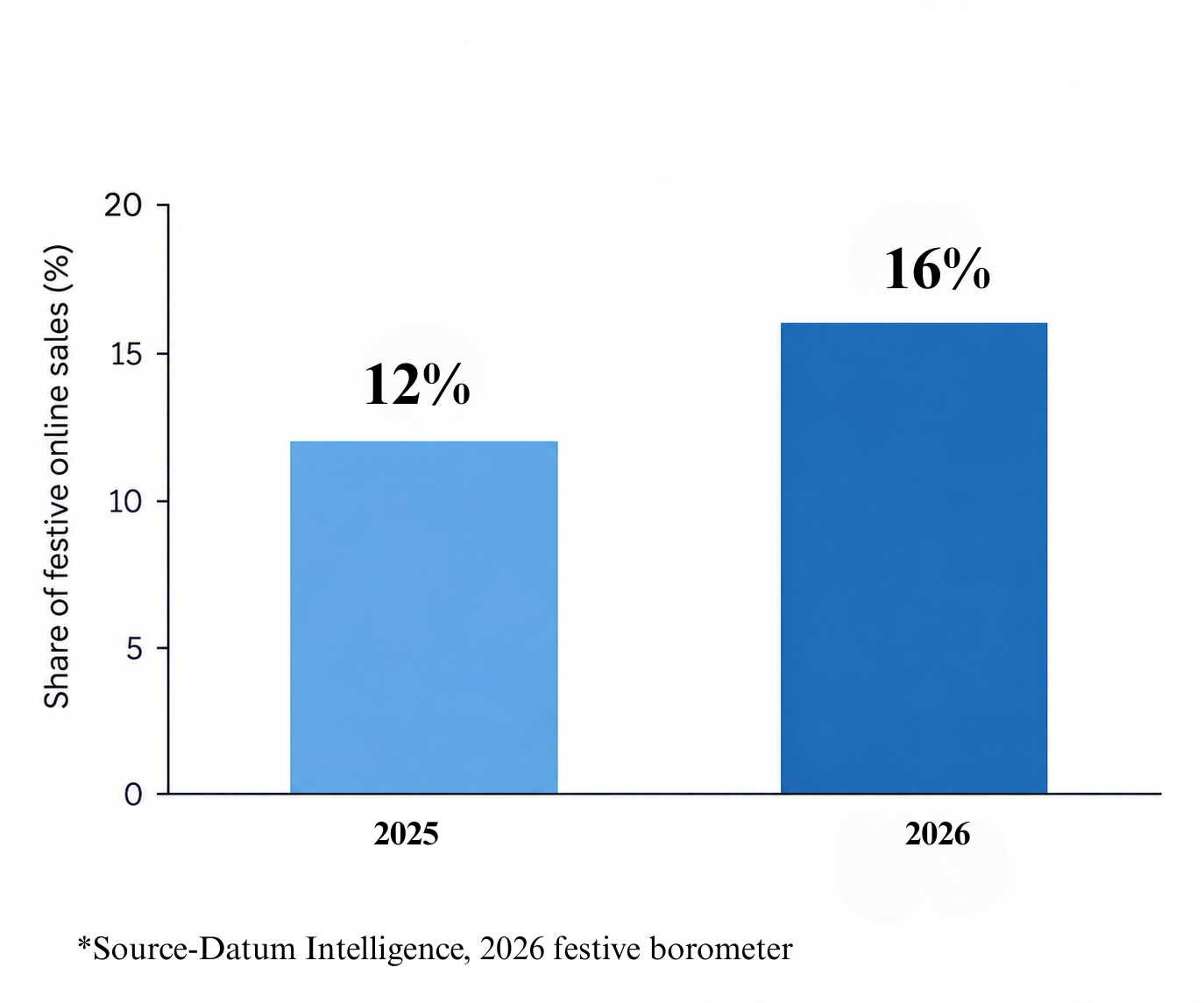
This creates a fundamental difference between traditional national retail planning and hyperlocal commerce. A large national campaign may promote one offer across millions of customers, but a quick-commerce platform can potentially make its assortment more relevant to a much smaller geographic audience. The products visible to a consumer in one city or neighbourhood do not necessarily have to be identical to the products shown somewhere else. If a particular occasion creates stronger demand in one market, the platform can adjust inventory, merchandising and promotional visibility accordingly.
The business logic is straightforward. India is not one homogeneous festive market. The products people buy, the food they prepare, the gifts they exchange and the rituals they follow can vary significantly by state, city, community and even neighbourhood. A retail model that can respond to those differences has the opportunity to turn cultural diversity into a commerce advantage.
Hyperlocal Commerce Is Changing What “Festive Shopping” Means
The phrase “festive shopping” traditionally brings to mind clothing, jewellery, electronics, home décor and large gifting purchases. Quick commerce is adding another layer to that definition. It is increasingly about the things people suddenly realise they need when a celebration is already underway.
A family may need additional sweets because guests arrived. Someone may realise they forgot a decoration. A person may need a last-minute gift before leaving for a celebration. A household may need ingredients for a traditional recipe. Someone preparing for a festival may need puja essentials, flowers, snacks or other occasion-specific products. These are not necessarily purchases that were planned several weeks earlier. They are purchases triggered by the immediate context.
That is where quick commerce fits naturally. Its value proposition is not only convenience but also immediacy. The consumer does not necessarily need to think about tomorrow's delivery or visit a physical store. The purchase can happen at the moment the need appears.
This behaviour is increasingly visible in the way brands are approaching the channel. Business Standard reported in August 2026 that D2C startups across food, beverages, fashion, consumer electronics and lifestyle categories were preparing festive launches specifically for quick-commerce platforms. Several companies described quick commerce not simply as a fulfilment channel but as a product launch and discovery platform.
That is a significant evolution. If a platform can become the place where consumers discover a product, rather than simply the place where they collect an item they already know they want, its role in the marketing funnel changes.
The Rise of Festival-Specific Products and Curated Packs
Another important change is the growing use of occasion-specific products. Instead of simply putting ordinary products into a festive category, brands are creating packs, bundles and SKUs that are designed around particular occasions.
Economic and retail reporting during 2026 has highlighted brands introducing premium gifting packs and occasion-specific products for festivals such as Raksha Bandhan, Onam and Ganesh Chaturthi, with quick commerce increasingly being used to reach consumers during these short demand windows.
The reason is partly psychological and partly practical. Consumers often do not think in terms of individual product categories when they are shopping for an occasion. They think in terms of a situation.
They are not necessarily thinking, “I need a chocolate product, a fragrance and a greeting card.” They may simply be thinking, “I need a gift for my sister.”
They are not necessarily thinking, “I need ingredients from four different grocery categories.” They may be thinking, “I am hosting people tonight.”
The occasion becomes the starting point, and the platform can organise products around that occasion. This is why curated assortments can be commercially powerful. They reduce the effort required from the customer to translate an occasion into a shopping list.
Raksha Bandhan Showed How Quickly Festive Demand Can Move
Raksha Bandhan 2026 provides a useful example of how quick commerce is becoming part of festive shopping behaviour. Business Standard reported that festival shopping on Flipkart Minutes grew threefold year over year during Raksha Bandhan, with Gen Z accounting for more than 40% of shoppers. The platform also reported strong growth in categories such as rakhis and fashion accessories, while gifting categories included mobile handsets, wireless earbuds, gold coins and smartwatches.
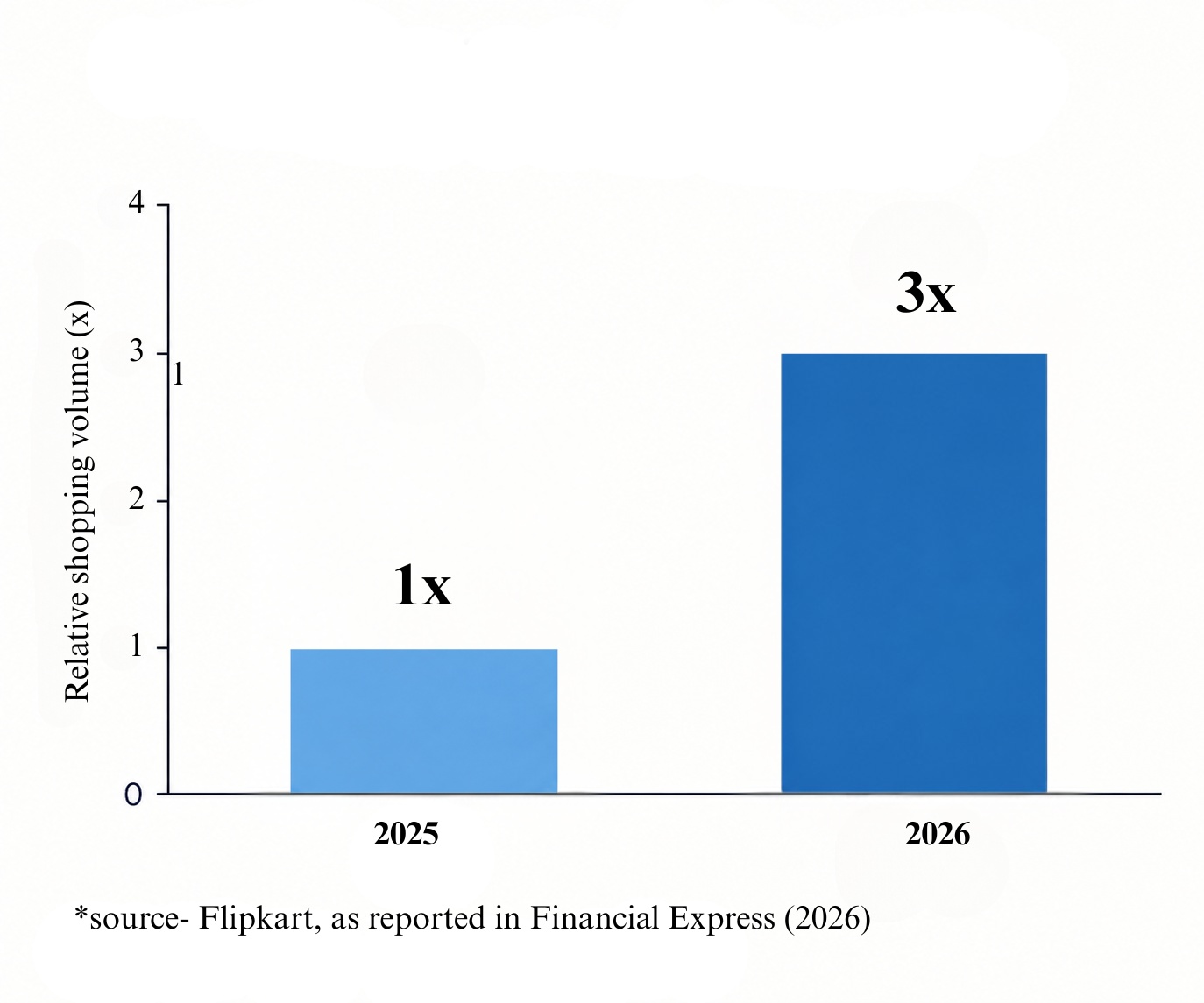
The significance of such numbers is not simply that a festival generated more orders. It shows how quickly the definition of quick-commerce demand is expanding. A customer using a quick-commerce platform for a festival is not necessarily buying only milk, snacks or household essentials. The platform can become part of the gifting journey as well.
That creates an interesting opportunity for brands. A brand that previously depended on traditional e-commerce, physical retail or its own website for festive discovery now has another environment in which it can present an occasion-specific product. For smaller brands, especially D2C companies, this can potentially reduce the distance between product launch and consumer discovery.
Quick Commerce Is Becoming a Discovery Channel for D2C Brands
The relationship between quick commerce and D2C brands is becoming particularly interesting. Business Standard reported that several D2C companies were planning new launches and assortment expansions on quick-commerce platforms during the 2026 festive season. The categories included food, beverages, fashion, consumer electronics and lifestyle products.
This suggests that quick commerce is gradually moving from a purely operational role into a marketing role. The platform is not simply responsible for getting an existing product from a warehouse to a customer. It can also become part of how the customer discovers the product in the first place.
For a new brand, that can be valuable. Traditional product discovery may require a customer to search deliberately, visit a website, see an advertisement or encounter a creator recommendation. Quick-commerce platforms introduce another behaviour: the consumer opens an app because they need something and discovers additional products while browsing.
Festive occasions make this behaviour even more relevant because shopping intent is often already elevated. A customer who opens an app to find a gift or celebration-related product may be more receptive to adjacent products that fit the same occasion.
The implication for brands is that availability and discoverability are becoming closely connected. Being listed on a quick-commerce platform is no longer necessarily just about delivery coverage. Placement, assortment, product packaging, search visibility and occasion-based merchandising can all influence whether a consumer notices the product.
Dark Stores Are Becoming the Infrastructure Behind Hyperlocal Festive Commerce
The ability to localise festive commerce depends heavily on infrastructure. Quick commerce cannot offer hyperlocal assortment without a network of fulfilment centres that can hold and replenish products close to customers.
Flipkart said in September 2026 that Flipkart Minutes had expanded to nearly 1,200 micro-fulfilment centres across more than 150 cities. The company also reported that its Tier-2-plus customer base had grown nearly 25 times year over year and that Gen Z customers were driving more than 45% of orders across several non-grocery categories.
These numbers illustrate why geographic expansion matters to the festive opportunity. As quick-commerce infrastructure moves beyond India's largest metros, platforms gain access to more regional demand patterns. A wider network means more markets where local festivals and occasions can be served with relevant inventory.
This is also why the dark-store model is more than a delivery infrastructure story. It becomes an inventory strategy. If a fulfilment centre serves a limited geographical area, the platform can use local purchasing patterns to determine which products deserve more space during a specific occasion.
In a traditional retail chain, changing the assortment across thousands of stores can be operationally difficult. In a digitally managed dark-store network, inventory can potentially be adjusted more frequently based on local demand signals.
India’s Regional Diversity Is Becoming a Retail Advantage
One of the most important things marketers need to understand about India is that “Indian consumers” are not one single consumer group. Regional culture affects food, gifting, fashion, celebrations and purchasing behaviour.
That has always been true, but digital commerce makes it easier to respond to these differences at scale.
A quick-commerce platform can potentially create different storefront experiences for different regions. A brand can launch products in markets where the relevant festival has higher cultural importance. A D2C company can test a regional product without immediately distributing it across the entire country. Retailers can use demand data to understand which occasions generate meaningful purchases in specific locations.
The result is a form of hyperlocal commerce where the physical infrastructure and digital interface work together.
This is particularly important as quick commerce expands outside the biggest metros. Flipkart's September 2026 update identified cities such as Ambala, Siliguri and Tiruppur among its fastest-growing markets, alongside the broader expansion of its Tier-2-plus customer base.
The future of festive commerce therefore may not be about making every city behave like Delhi or Mumbai. It may be about giving different cities more room to behave like themselves.
The Consumer Is Also Becoming More Comfortable With Quick Commerce
The expansion of quick commerce into festive categories depends on a basic consumer question: will people actually trust the channel for these purchases?
Recent industry evidence suggests that consumers are increasingly comfortable using quick commerce for categories beyond traditional grocery. The Economic Times reported in September 2026 that quick commerce was expanding beyond its grocery origins, with industry executives pointing to festive-specific SKUs and growing use for electronics and urgent purchases. At the same time, the report noted that traditional e-commerce continues to have advantages for categories where discovery, extensive assortment and price comparison are more important.
This distinction is important. Quick commerce is not necessarily replacing every form of e-commerce. The two models can serve different consumer needs.
Traditional e-commerce may be more suitable when someone is comparing dozens of products, reading reviews, evaluating specifications or planning a large purchase. Quick commerce can be more attractive when the customer already knows what they want, needs it quickly, or is responding to an immediate occasion.
Festive shopping contains both types of behaviour. Someone may spend days researching a television before Diwali, while simultaneously ordering sweets, decorations or a last-minute gift through a quick-commerce app.
The two shopping journeys can exist side by side.
From “Festive Season” to “Festive Moments”
This is where the larger business story becomes interesting.
The traditional retail model thinks in seasons. Businesses prepare for a major period, allocate budgets, launch campaigns and attempt to capture as much demand as possible during that window.
Quick commerce introduces a more granular way of thinking.
Instead of asking, “What are we doing for the festive season?” a business can ask:
What occasions are happening in our market over the next few weeks?
What products become relevant during each occasion?
Which customers are likely to need them?
How quickly does the need emerge?
Can we make the product available at the exact moment that need appears?
That is a very different commercial mindset.
It turns the retail calendar into a series of smaller opportunities instead of one large event.
Inc42's reporting on the sector has described this broader direction in terms of quick commerce responding to cultural moments and micro-festivals, while industry analysis has also highlighted hyperlocal forecasting, SKU-level planning and replenishment as increasingly important during the festive period.
The idea is not that every small event will become a major sales opportunity. Rather, digital commerce gives businesses the ability to identify and respond to more of these occasions than traditional retail models could easily support.
Why Availability May Matter More Than Discounts
There is another subtle but important implication in the 2026 festive outlook.
Datum Intelligence expects festive growth to come primarily from more orders rather than larger average baskets. The report argues that a volume-driven season places greater importance on availability, fulfilment capacity and delivery reliability than a season driven primarily by larger transaction values.
For quick commerce, this is especially relevant.
The entire promise of the model depends on the product being available when the customer wants it. If a consumer searches for a festival-specific product and discovers that it is unavailable, speed becomes irrelevant.
This means festive planning increasingly becomes an inventory problem as much as a marketing problem.
A brand can create an excellent campaign, generate awareness and attract demand, but if the relevant SKU is unavailable in the customer's local fulfilment centre, the marketing opportunity can disappear at the final step.
For marketers, this creates an important connection between media, merchandising and operations. The campaign and the inventory need to work together.
What This Means for Brands in 2026
For brands, the growth of quick commerce creates a new way to think about festive marketing. Instead of building every strategy around a single national campaign, brands can identify occasions where their products naturally fit the consumer need and build smaller, more relevant activations around them.
A beauty brand, for example, may not need to create a completely different product for every festival. But a strong digital marketing strategy can help brands identify the occasions, audiences and search behaviour that matter most.
A food brand can think about recipes, hosting and regional celebrations. A personal-care brand can think about gifting. A home brand can think about decoration and hosting. A fashion brand can think about last-minute accessories and event-specific requirements.
The important part is relevance.
The opportunity is not to put the word “festive” on every product.
The opportunity is to understand why a consumer might need that product at that particular moment.
That is a much more useful way to think about occasion-based marketing.
The Quick-Commerce Competition Is No Longer Only About Speed
Quick commerce was built on a very simple competitive promise: faster delivery.
But as more companies expand their fulfilment networks and consumers become accustomed to rapid delivery, speed alone becomes less distinctive.
The next layer of competition is likely to involve assortment, availability, discovery, localisation and relevance.
Can the platform provide the right product?
Can it provide the right variant?
Can it stock it in the right location?
Can it surface at the right time?
Can it help a customer solve an occasion rather than simply find an individual product?
These questions explain why festive commerce is becoming strategically important for quick-commerce platforms. The festive period gives companies a chance to demonstrate whether their infrastructure, assortment and customer experience can respond to complex demand at scale.
The Bigger Business Story Behind India’s Festive Commerce
The rise of regional and occasion-based quick commerce is ultimately part of a broader transformation in Indian retail.
Consumers have more digital choices than ever before. They can shop from marketplaces, brand websites, social platforms, quick-commerce apps and physical stores, often moving between several channels during the same purchase journey.
That means brands are no longer competing only for a customer's annual festive budget.
They are competing for individual moments of attention and need.
A customer might discover a product on Instagram, research it on Google, compare it on a marketplace and finally buy something immediately through a quick-commerce platform. Another customer might see a product inside a quick-commerce app without having planned to buy it at all.
The journey is becoming fragmented, contextual and increasingly immediate.
This is why the idea of “festive season” is becoming less precise as a description of consumer behaviour.
There is still a major Diwali shopping season.
There are still large e-commerce events.
There are still national campaigns.
But underneath them is a much more detailed layer of regional celebrations, gifting occasions, cultural moments and last-minute needs.
Quick commerce is building infrastructure to capture that layer.
India Doesn’t Have One Festive Season Anymore
The most interesting thing happening in Indian festive commerce is not simply that quick-commerce platforms are selling more products.
It is that they are changing the unit of commerce.
The unit is no longer always the large shopping event.
Sometimes it is a festival.
Sometimes it is a regional celebration.
Sometimes it is a gift.
Sometimes it is a forgotten item.
Sometimes it is a celebration that starts tonight.
And sometimes it is simply a moment when someone realises they need something immediately.
India's festive calendar has always been diverse. What has changed is the ability of digital commerce infrastructure to respond to that diversity at scale.
With India's festive online sales projected at ₹1.50–₹1.55 lakh crore in 2026, quick commerce expected to take a larger share of festive online sales, and platforms continuing to expand into smaller cities and non-grocery categories, the direction is becoming clearer: festive commerce is becoming more frequent, more local and more contextual.
The future may therefore not belong only to the platform that creates the biggest Diwali sale.
It may also belong to the platforms and brands that understand the smaller moments leading up to it.
Because in a country as diverse as India, there was never really just one festive season.
There were always hundreds of them.
Digital commerce is simply making more of them commercially visible.
Frequently Asked Questions
What is quick commerce in India?
Quick commerce refers to digital commerce models designed to deliver products to consumers within a short period, typically using a network of local dark stores or micro-fulfilment centres. While the category initially became closely associated with grocery and everyday essentials, platforms are increasingly expanding into gifting, electronics, beauty, fashion and festive merchandise.
How is quick commerce changing festive shopping in India?
Quick commerce is making festive shopping more immediate and localised. Consumers can purchase not only planned festive products but also last-minute gifts, food, decorations and occasion-specific items. Platforms can also adjust assortment and inventory according to local demand, making regional festivals more commercially relevant.
Why are regional festivals becoming important for quick commerce?
Regional festivals generate geographically concentrated demand. Because quick-commerce platforms operate through local fulfilment networks, they can potentially stock and promote products that are particularly relevant to specific regions instead of offering exactly the same festive assortment nationwide.
Are quick-commerce platforms replacing traditional e-commerce?
Not necessarily. Current industry reporting indicates that the two models often serve different consumer needs. Quick commerce is particularly suited to immediacy and urgent purchases, while traditional e-commerce remains useful for categories involving extensive discovery, larger assortment and price comparison.
Why are D2C brands launching products on quick-commerce platforms?
D2C companies are increasingly using quick commerce for product discovery, launches and distribution. The channel can put a product in front of consumers who are already shopping for an occasion, while also offering rapid fulfilment. Industry reporting in 2026 has documented D2C launches across food, beverages, fashion, electronics and lifestyle categories.
What is hyperlocal commerce?
Hyperlocal commerce refers to a model in which products, inventory, marketing or fulfilment are adapted to a relatively small geographic market. In quick commerce, local dark stores allow platforms to respond to demand patterns in specific cities, neighbourhoods or service areas.
What is the future of festive shopping in India?
The available 2026 industry data points towards a festive commerce environment with more online orders, broader quick-commerce participation, growing non-metro demand and greater use of regional and occasion-specific assortments. Rather than eliminating traditional festive shopping, quick commerce is adding another layer based on immediacy and local relevance.
Sources and Further Reading
- Datum Intelligence — 2026 Festive Outlook: data and projections for India's 2026 festive online market, order growth and festive window.
- Financial Express — Q-comm bets on small events in stretched festival season: reporting on regional festivals, hyperlocal assortment and the expanding quick-commerce festive opportunity.
- The Economic Times — India's festive season promises strong show as quick commerce reshapes online shopping: industry commentary on festive-specific SKUs, quick commerce and consumer behaviour.
- Flipkart Stories — Flipkart Minutes Marks Two Years with 4X Growth: official company data on micro-fulfilment centres, cities and Tier-2+ growth.
- Business Standard — D2C startups turn to qcom platforms for festive launches: reporting on quick commerce as a product launch and discovery channel.
- Business Standard — Q-com and e-com platforms see surge in premium, personalised Rakhi demand: festive demand data from Flipkart Minutes.
- Inc42 — Inside Dark Store Festive Stock Up Strategy: analysis of hyperlocal forecasting, dark-store allocation and festive inventory planning.
- MMA Global — The Quick Commerce Playbook India: research on India's evolving quick-commerce ecosystem and festive commerce.