
How to Check If a Website Is Genuine Before You Pay Online
 Sachin Gupta26 Oct 2026
Buying from an unfamiliar website? Learn how to verify the seller, spot suspicious offers, check payment details and protect yourself before paying online.
Summarize this article with AI
To check if a website is genuine before paying online, verify its URL, business details, independent customer reviews, return and refund policy, and payment process. Watch for suspicious discounts, inconsistent information, and requests for sensitive banking details. No single check guarantees a website is safe, so look for multiple trustworthy signals before making a payment.
You find a product online at an unbelievable price. The website looks professional, the photos look real, and the discount seems too good to miss.
But something feels slightly off.
Should you place the order, or could it be a fake website?
With so many people shopping, booking services and making payments online, knowing how to check if a website is genuine before paying has become an important digital skill. A website can look professional without being trustworthy, and a low price does not automatically mean you have found a good deal.
The good news is that you can check several warning signs before sharing your payment details.
Here is how to evaluate a website, what to look for before making a payment, and what to do if something goes wrong.
How to Check If a Website Is Genuine
There is no single test that can guarantee a website is safe. Instead, look at several signals together, including the website address, business details, payment options, reviews and the way the website communicates with you.
1. Check the Website URL Carefully
Start with the website address in your browser.
Scam websites sometimes use addresses that resemble the names of well-known brands. A small spelling difference, an extra word or an unfamiliar domain can be easy to miss when you are in a hurry.
For example, a suspicious address might imitate a familiar shopping brand by adding extra words or changing a letter.
Before placing an order:
- Check the spelling of the domain name.
- Look for unexpected words or unusual combinations.
- Avoid relying on links sent through unsolicited messages.
- If a brand has an official website, navigate to it independently rather than trusting a promotional link.
- Be cautious when a website redirects you to an unrelated domain during payment.
Also, remember that HTTPS and the padlock symbol do not prove that a website is genuine. They indicate that the connection is encrypted, but fraudulent websites can use HTTPS too.
2. Look for Real Business Information
A genuine business should make it reasonably easy to understand who is operating the website and how to contact them.
Look for details such as:
- Business or company name
- Contact information
- Physical address, where applicable
- Customer support details
- Return, refund and cancellation policies
- Terms and conditions
- Privacy policy
Check whether these details are consistent across the website.
For example, a website may display one business name in its footer and a completely different name in its payment instructions. That inconsistency deserves further investigation.
Be careful with websites that provide only a generic email address, have no usable contact information, or display policies that appear copied, incomplete or unrelated to the business.
However, missing information alone does not conclusively prove fraud. Use it as one signal alongside other checks.
3. Be Careful With Prices That Look Too Good to Be True
Imagine you find a smartphone listed for ₹8,000 on a website, while established retailers are selling the same model for considerably more.
It could be a genuine clearance offer, but it could also be a warning sign.
Before buying, compare the price with the brand's official store and other established retailers. Check whether the offer has a clear explanation, whether the product is new or refurbished, and whether additional charges appear at checkout.
Be especially cautious when the website combines an unusually low price with countdown timers, pressure to pay immediately, or claims that only one item remains.
A discount is not proof of fraud. But an extraordinary discount with no credible explanation should prompt more checks before you pay.
4. Search for Independent Customer Reviews
Customer reviews can help you understand how a business behaves after receiving payment.
Search for the business name along with phrases such as:
- Reviews
- Complaints
- Refund problems
- Delivery issues
- Customer experiences
Look beyond the testimonials published on the website itself. Independent reviews may reveal recurring complaints that are not visible on the seller's own pages.
Pay attention to patterns rather than one isolated negative review. For example, repeated reports of orders never arriving, refunds not being processed or customer support becoming unreachable are more concerning than a single disagreement about delivery time.
Also, be cautious of reviews that all use nearly identical wording, appear in large numbers within a short period, or provide little specific information.
Reviews can be fake or manipulated, so they should support your decision rather than determine it entirely.
5. Check the Website's Return and Refund Policy
Before ordering, understand what happens if the product never arrives, arrives damaged or is different from what you expected.
Read the return, replacement, refund and cancellation policies carefully.
Ask yourself:
- Is the return period clearly stated?
- Are the conditions for refunds understandable?
- Does the website explain how to contact customer support?
- Are there unexpected restrictions or charges?
- Does the policy name the same business that operates the website?
A website with vague policies or conflicting information may create problems if you need help later.
For expensive purchases, read the policy before paying rather than assuming that every online retailer offers the same return options.
6. Understand the Payment Options
The payment process can provide important clues about how a seller operates.
Be cautious if a website pressures you to transfer money to an unrelated personal account, asks you to pay through an unfamiliar link, or requests your UPI PIN or OTP to receive a refund.
Never share your UPI PIN or banking OTP with a seller or customer-support agent. Enter payment credentials only through the appropriate payment interface when you have initiated a transaction yourself.
A familiar payment gateway does not guarantee that the seller is trustworthy, and the availability of cash on delivery does not guarantee that the product will be genuine.
Before confirming payment, check the recipient details and the amount displayed on the payment screen. If the recipient does not match the business or transaction you expected, stop and verify the details independently.
7. Check the Website's Age and Online Presence
A business's online history can provide useful context.
You can use a domain lookup service, such as ICANN Lookup, to check publicly available registration information for a domain.
A newly registered domain is not automatically fraudulent. Legitimate businesses launch new websites every day. However, a recently created website offering unusually large discounts while claiming to be a long-established retailer deserves closer examination.
You can also check whether the business has a consistent presence across its official website, social accounts and independent business listings.
Look for a history that makes sense: consistent branding, meaningful customer interactions and business information that matches across channels.
An established online presence is a useful signal, but it is not an absolute guarantee of safety.
8. Look for Pressure Tactics and Suspicious Messages
Some fraudulent websites rely on urgency to stop people from checking the details.
You might see messages such as:
- “Pay in the next five minutes or lose the offer.”
- “Your account will be blocked unless you verify immediately.”
- “You have won a prize. Pay a small fee to claim it.”
- “Your parcel is held. Pay now to release it.”
Not every countdown timer or urgent notification is fraudulent. However, unexpected demands for immediate payment or sensitive information should be treated carefully.
If a message claims to come from a bank, courier, government department or familiar company, contact that organisation through its official website or app instead of following the message's link.
The time you spend verifying the request can be more valuable than the discount or reward being offered.
Quick Example: Would You Trust This Website?
Imagine you discover an unfamiliar website selling branded shoes at a huge discount.
Here is what you find:
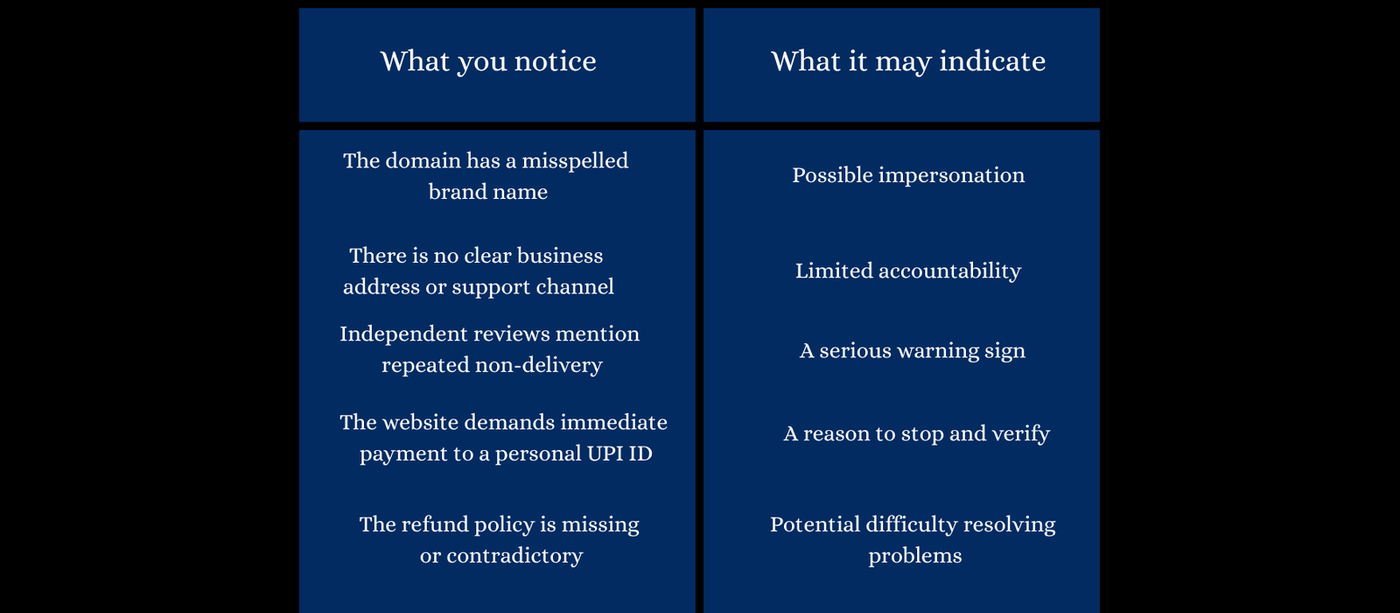
One warning sign may have an innocent explanation. Several independent warning signs together make the purchase much harder to justify.
In this example, the sensible decision would be to avoid paying until the seller's identity and credibility can be verified.
How to Check If a Website Is Safe on Your Phone
You do not need a computer to carry out these checks.
When shopping on your mobile phone:
- Tap the browser's address bar to inspect the full domain.
- Open a separate browser tab and search for the business independently.
- Read reviews from sources other than the seller's own website.
- Open the contact, return and refund policy pages.
- Check the recipient and amount before confirming a payment.
- Avoid installing unknown apps or downloading files just to complete a purchase.
If a link arrives through WhatsApp, SMS or social media, do not assume it is legitimate because it was shared by someone you know. Accounts can be compromised, and misleading offers can spread quickly.
When in doubt, open the official website or app yourself.
What Should You Do If You Have Already Paid for a Fake Website?
If you suspect that you have paid a fraudulent seller, act promptly.
1. Contact your bank or payment provider. Report the transaction and ask what immediate protective steps are available.
2. Report suspected cyber financial fraud in India. Call the national cybercrime helpline at 1930 as soon as possible and follow the instructions provided. You can also use the National Cyber Crime Reporting Portal.
3. Preserve evidence. Save transaction references, payment screenshots, order confirmations, website URLs, messages and any communication with the seller.
4. Change exposed credentials. If you shared a password or entered it on a suspicious website, change it through the official service. If you installed an unknown app, review its permissions and seek help securing your device if needed.
5. Raise a consumer grievance where appropriate. For consumer complaints about a seller or service, you can contact India's National Consumer Helpline or call 1915.
A complaint does not guarantee recovery of money, but reporting quickly may help the relevant institutions respond. Avoid anyone who promises guaranteed recovery in exchange for an advance fee.
Why a Professional-Looking Website Is Not Enough
A polished design can make a website easier to use, but it cannot establish that the business behind it is trustworthy.
A website can look professional but still leave visitors confused or uncertain about taking the next step. Read our guide on why your website is not generating leads to understand how website experience and trust can affect conversions.
Fraudulent websites can use professional layouts, copied product photos, convincing logos and fabricated testimonials. Legitimate websites, meanwhile, can sometimes have outdated designs or technical issues.
That is why trust should be evaluated through several signals together: business identity, consistent information, transparent policies, independent feedback and a payment process that makes sense.
For businesses, the lesson is equally important. A website should not merely look professional; it should help visitors understand who they are dealing with, what they are buying and what support is available after the transaction.
Clear contact information, accurate policies and honest communication can help customers make more informed decisions.
For businesses, building customer confidence starts with a website that is clear, responsive, and easy to navigate. Explore Digivanta's website development services to learn more about creating user-friendly digital experiences.
Frequently Asked Questions
How can I check if a website is genuine?
Check the URL, business details, independent reviews, return policy, payment process and online history. Look for multiple consistent signals rather than relying on one feature.
Does HTTPS mean a website is safe?
No. HTTPS encrypts the connection between your browser and the website, but it does not prove that the website operator is legitimate or that the offer is genuine.
Can a fake website have customer reviews?
Yes. Reviews and testimonials can be copied, fabricated or manipulated. Check independent sources and look for consistent patterns across multiple reviews.
Is a newly created website always a scam?
No. New businesses regularly launch websites. A recently registered domain is only one piece of information and should be considered alongside the seller's identity, offer, policies and reputation.
What should I do if I enter my banking details on a suspicious website?
Contact your bank or payment provider promptly, follow their security instructions and change any exposed passwords through official channels. If you suspect financial cyber fraud in India, call 1930 and report it through the official cybercrime reporting portal.
Where can I report an online shopping complaint in India?
For consumer grievances, visit the National Consumer Helpline at consumerhelpline.gov.in or call 1915. For suspected cyber financial fraud, contact 1930 and use cybercrime.gov.in.
Final Thoughts
Before paying an unfamiliar website, take a moment to look beyond the discount and the design.
Check the address, investigate the business, read independent reviews, understand the refund policy and verify the payment details. None of these checks can guarantee that a website is safe, but together they can help you make a better-informed decision.
Online shopping should make life easier, not leave you wondering whether your money will reach the right person.
A website can look trustworthy in seconds. Verifying the business behind it takes a little more effort and that effort can matter.