Google Search Is Changing in 2026: Are Keywords Still Enough for SEO?
 Sachin Gupta28 Sept 2026
Google Search is changing fast with AI Mode, AI Overviews and multimodal search. Here’s what the latest updates mean for SEO, keywords and website visibility in 2026.
Summarize this article with AI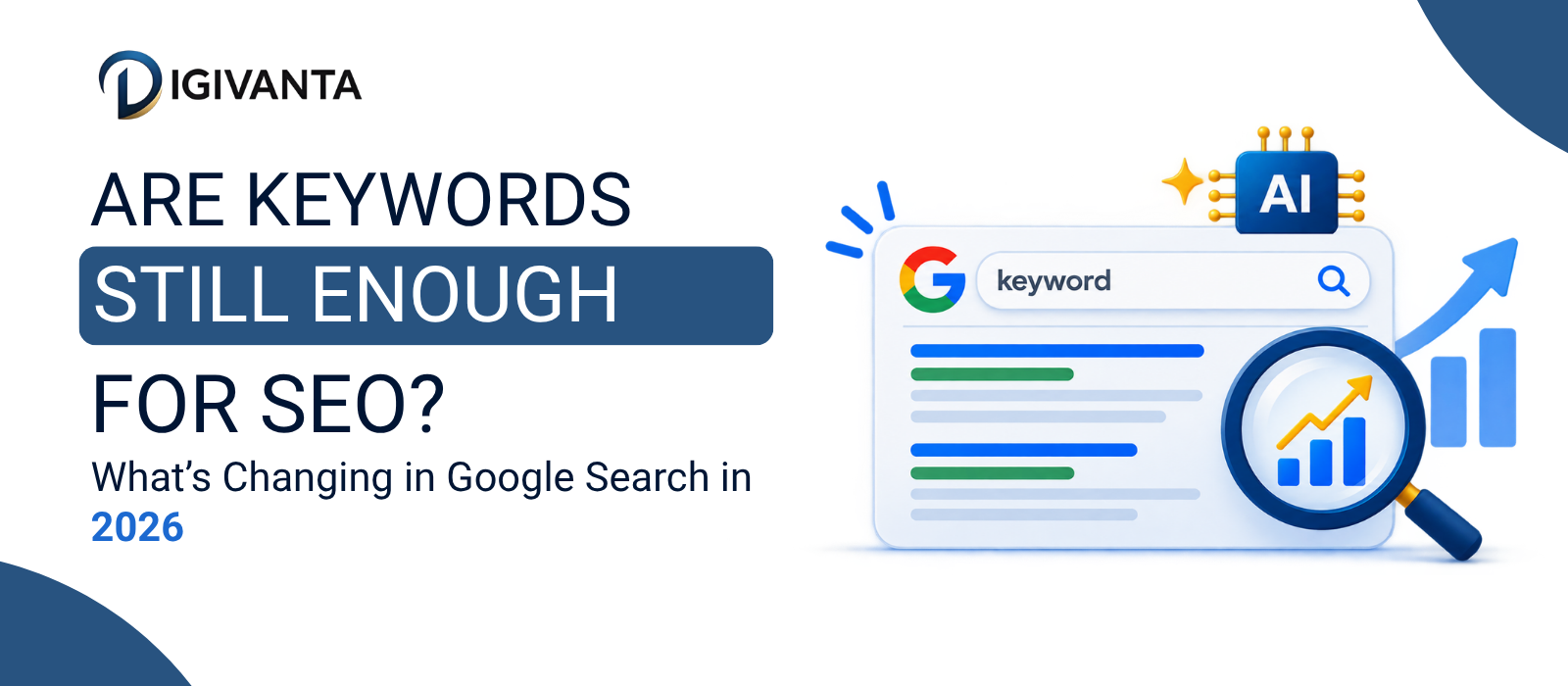
For years, search engine optimization followed a fairly predictable pattern. Someone typed a phrase into Google, the search engine returned a list of results, and businesses tried to get their pages as high as possible for the keywords that mattered to them. Keyword research, on-page optimization, backlinks and technical SEO became the foundation of organic search. That model still exists, but Google Search in 2026 is becoming much more than a text box followed by ten blue links.
People can now search with longer questions, continue a conversation with Search, use AI-powered results, upload images, use Google Lens, circle something on their phone screen and search for it, or use an image from Chrome to find related information. Google is also giving website owners new ways to understand some of these behaviours. On September 24, 2026, Google announced web multimodal Search performance reporting in Google Search Console, allowing site owners to see performance from web searches that use images through experiences such as Google Lens, Circle to Search on Android, image uploads to Google Search and Chrome's “Search this image” feature. The rollout is global.
That update may look like a small Search Console feature, but it points towards a much bigger change in how websites are discovered. Search is gradually becoming more conversational, visual and contextual. For businesses and SEO professionals, the question is no longer simply whether a page contains the right keyword. The more useful question is whether the page understands what the searcher is trying to accomplish and provides the information, context and experience they need.
What Is Changing in Google Search in 2026?
Google is increasingly combining traditional search with AI-powered experiences. At Google I/O 2026, Google said AI Overviews had more than 2.5 billion monthly active users and AI Mode had surpassed 1 billion monthly users. Google also described Search as becoming more conversational, with people using AI-powered features to ask new kinds of questions and continue their searches rather than treating every query as a completely separate interaction.
This does not mean that traditional Google Search has disappeared. Websites still appear in Search, and keywords remain useful for understanding what people are looking for. What is changing is the number of ways a user can reach information. A person may begin with a traditional search, read an AI-generated overview, ask a follow-up question, open a website, return to Search with a more specific question, or use an image to continue the discovery process.
That creates a more complicated search journey for businesses. A website is no longer competing only for a single position against another webpage. Its content can potentially be discovered through different search formats, depending on what the user is trying to find and how that user chooses to search.
What Did Google Announce on September 24, 2026?
The latest major development behind this discussion is Google's September 24 announcement of web multimodal Search performance reporting in Google Search Console.
The new reporting allows website owners to distinguish multimodal searches from traditional text-based web searches in Search Console's performance reports. Google says the data includes searches involving Google Lens, Circle to Search on Android, image uploads to Google Search and Chrome's “Search this image” functionality. The reporting is also available in the performance report for Generative AI features, and Google says the new data is rolling out globally.
In practical terms, this gives publishers and businesses another way to understand how users discover their content. A website that receives visitors through an image-related search may now have more visibility into that activity than it did before. The significance is particularly clear for websites where visual information is central to the user's decision, including ecommerce stores, fashion websites, beauty brands, restaurants, travel businesses, home-interior websites and product publishers.
The important point is that Google is not saying that every website will suddenly receive large amounts of traffic from visual search. The new reporting is a measurement capability. If a site is receiving traffic from these types of queries, Search Console can begin showing the relevant performance data as the rollout reaches that property.
What Is Multimodal Search?
Multimodal search simply means that a person can use more than traditional typed text as part of the search experience.
A traditional search might be someone typing “white sneakers for women” into Google. A multimodal search could begin with a photograph of a pair of sneakers. The user may want to identify the product, find similar products, learn more about it or locate a website where it is available.
The difference is important because the user does not necessarily need to know the correct keyword before beginning the search. They can show Google what they mean.
This changes one of the assumptions behind traditional keyword research. Historically, SEO teams spent considerable time trying to understand which words people use to describe a product, service or problem. That remains valuable, but visual search adds another layer because the user's starting point may not be a word at all.
For a fashion brand, the search could begin with an outfit photograph. For a furniture website, it could begin with a picture of a chair. For a beauty company, it could begin with a makeup look. For a travel website, it could begin with a photograph of a landmark.
In each case, the website's opportunity depends not only on the words surrounding its content but also on whether its visual assets are useful, relevant and discoverable.
Does This Mean Keywords Are No Longer Important?
No. Keywords are still an important part of SEO.
Search engines need language to understand the subject of a webpage, and keyword research remains useful for understanding demand, terminology and the questions people ask. What is changing is the idea that SEO success can be reduced to placing an exact phrase repeatedly on a page.
Consider the keyword “digital marketing agency.”
A page that repeats that phrase twenty times does not automatically provide a better answer than a page that explains what a digital marketing agency does, which services it provides, who those services are suitable for, how the services work together and what a potential client should consider before choosing an agency.
The second page provides context.
That context becomes increasingly important as search systems become better at interpreting longer questions and relationships between concepts. A strong SEO content strategy therefore needs to connect keywords with search intent, subject depth and usefulness rather than treating keywords as isolated targets.
The better question is not “How many times should I use my keyword?” It is “What does the person searching this keyword actually need to understand?”
Why Search Intent Matters More Than Ever
Search intent is the reason behind a search.
Someone searching “SEO” could be looking for a definition, a service provider, a course, an SEO tool or the latest industry news. The phrase alone does not tell you exactly what that person wants.
Compare that with a search such as “how long does SEO take for a small business?” The intent is much clearer. The person is looking for an explanation and probably wants realistic expectations before investing time or money.
This is why content designed for modern search should answer the underlying question instead of simply matching the visible keyword.
For businesses, that means understanding the different stages of the customer journey. A person researching a problem may need educational content. Someone comparing solutions needs more detailed information. Someone who already knows what they want may need a product or service page. A useful SEO strategy connects these different needs instead of creating pages that all repeat the same basic information.
Google AI Search Is Making Queries More Conversational
The growth of AI-powered Search is another reason the traditional keyword-only mindset is changing.
Google says AI Mode has surpassed 1 billion monthly users globally, while AI Overviews has more than 2.5 billion monthly active users. Google has also described Search as becoming more conversational, with people asking new kinds of questions and continuing conversations rather than relying only on short keyword combinations.
This matters because conversational searches contain more context.
A person might search:
“best digital marketing agency”
But they could also ask:
“What should a small business look for when choosing a digital marketing agency in Delhi?”
The second question gives a search engine far more information about the user's situation, purpose and expectations.
For content creators, this means a page should be capable of answering the main question as well as the natural follow-up questions that come with it.
This is also where AEO, or Answer Engine Optimization, becomes relevant. AEO is not a replacement for SEO. It is a way of thinking about how content can provide clear, useful answers that can be understood by search systems and users alike.
What Is the Connection Between SEO and AEO?
SEO focuses broadly on helping content become discoverable and useful within search engines. AEO puts additional emphasis on answering questions clearly and directly in formats that are easy for search systems to interpret.
For example, if an article discusses multimodal search, it should not force the reader to search somewhere else for the definition. It should simply explain it.
That is why an AEO-friendly article often contains clear questions and direct answers within naturally written sections.
Instead of writing a vague paragraph about visual search, a useful article can directly answer:
What is multimodal search?
Multimodal search allows users to search using combinations of inputs such as text and images, including visual experiences such as Google Lens and other image-based search interactions.
That answer can then be followed by a deeper explanation.
This structure benefits readers first. It also makes important information easier for search systems to identify.
Why Visual Content Is Becoming Part of SEO Strategy
The new Search Console reporting makes one thing particularly clear: visual discovery deserves more attention from website owners.
Images have traditionally been treated as supporting elements. A website owner might choose an image for design purposes and then add a filename or alt text almost as an afterthought.
That approach is becoming less useful.
If users can discover content through visual search, images should contribute meaningfully to the page. Product photographs should clearly represent the product. Editorial images should support the subject being discussed. Infographics should contain genuinely useful information. Image filenames and alternative text should describe the image accurately rather than being stuffed with keywords.
This does not mean turning every image into a list of search phrases. The goal is clarity.
If an image shows a woman applying a skincare product, describing the image accurately is more useful than forcing an unrelated keyword into the alt text.
Image SEO should support the page rather than operate separately from it.
What Businesses Should Do About Google Search Changes
Businesses do not need to abandon their existing SEO strategy because Google Search is evolving. They need to broaden it.
Keyword research should continue because it provides valuable information about what people are searching for. But the research should be combined with questions, related topics, search intent, competitor content, customer language and the different ways users may discover information.
A service page should explain the service clearly instead of only targeting the service name. A product page should answer practical questions instead of only describing the product. A blog should solve a real information need instead of existing solely to capture a keyword.
Visual assets should also be treated as part of the content experience. This is particularly important for ecommerce and visually driven industries, where an image may communicate information that would take several sentences to describe.
Most importantly, businesses should avoid reacting to every Search update by creating a completely new strategy. Google's September 24 update is a reporting improvement. It gives site owners more information about multimodal search performance; it does not mean that every SEO principle has suddenly changed.
How to Use Google Search Console After the Multimodal Update
If you manage a website, Google Search Console is the natural place to start.
The Performance report can help you understand how your website is appearing in Search, and the new multimodal search type provides an additional view for eligible sites receiving this type of traffic. Google says users can select the new multimodal search type filter and export the data for further analysis.
The useful approach is to compare this information with the rest of your Search Console data. Look at which pages receive visibility, which queries are associated with them and whether the pages are important to your business.
For ecommerce businesses, product and category pages may deserve particular attention. For service businesses, the more relevant opportunity may come from visual examples, project pages, case studies or informative content. For publishers, images and explanatory graphics can become part of the broader discovery experience.
The objective is not to chase a new metric simply because it exists. The objective is to understand whether the way people discover your website is changing.
What About the September 2026 Spam Update?
There is another important Google Search development happening at the same time.
Google's Search Status Dashboard shows that the September 2026 spam update began on September 24, 2026, affects ranking, applies globally and covers all languages. Google says the rollout may take up to two weeks to complete. As of September 28, the dashboard still lists the update as active.
This is separate from the September 24 multimodal Search Console reporting announcement.
That distinction matters.
The multimodal update is primarily about measurement and visibility into a newer search format, while the spam update concerns Google's ranking systems and spam detection.
Website owners should therefore avoid assuming that every ranking movement around September 24 is caused by the new multimodal reporting feature. The reporting change does not itself mean that Google has changed how a page ranks in visual search.
If a website experiences ranking changes during the September spam update, the sensible approach is to analyse the site's traffic, queries, affected pages and Search Console data while remembering that the rollout is still in progress.
What This Means for SEO in 2026
The biggest change in SEO is not that keywords have disappeared. It is that the search journey is becoming more varied.
A person can discover a business through a traditional text query, an AI-powered answer, a conversational follow-up, a visual search, Google Lens or another multimodal experience. These paths can overlap, and the same user may move between them during a single research journey.
That makes context increasingly important.
A website that only targets isolated keywords may struggle to answer the broader questions people have. A website that builds genuinely useful topical coverage has more opportunities to meet different forms of search intent.
This is why SEO in 2026 should be thought of as more than ranking for keywords. It is about creating information that can be discovered and understood across an increasingly diverse search environment.
Are Keywords Still Enough?
Keywords alone are not enough.
But keywords are not obsolete either.
The stronger approach is to use keyword research as the starting point and then build content around the subject, intent and questions behind those searches. Add useful supporting information, accurate visuals, clear explanations and strong internal connections between related pages.
The shift is subtle but important.
Old thinking asks:
“Which keyword should this page rank for?”
A broader 2026 approach asks:
“What does the searcher want to accomplish, and how can this page become the most useful resource for that need?”
That change in thinking can influence everything from content planning and website structure to image optimization and internal linking.
What Website Owners Should Watch Next
Google Search is likely to continue evolving as AI and multimodal experiences become more deeply integrated into the search journey. The safest strategy is not to predict every future feature. It is to build a website that is technically accessible, useful, trustworthy and easy for both users and search systems to understand.
For businesses, this means continuing to invest in strong fundamentals while adapting to new search behaviours. Keep important pages updated. Understand what customers actually ask. Create original information instead of rewriting what everyone else has already published. Use images where they genuinely add value. Make pages easy to navigate. Monitor Search Console and analytics rather than relying only on ranking positions.
The September 2026 multimodal reporting update is useful precisely because it gives website owners another window into how discovery is changing. Instead of guessing whether visual search matters to a particular website, businesses can increasingly look at their own performance data.
That is a more useful way to approach the future of SEO.
Final Takeaway
Google Search in 2026 is not becoming a completely different product overnight. It is evolving from a primarily text-based discovery system into a broader environment where people can search through conversations, questions, images and AI-powered experiences.
Google's September 24, 2026 introduction of multimodal Search reporting in Search Console is one visible example of that shift. At the same time, Google's continued expansion of AI Overviews and AI Mode shows that the search experience itself is becoming more conversational.
For businesses, the answer is not to stop using keywords.
The answer is to stop treating keywords as the entire SEO strategy.
Keywords tell you what people search for. Search intent helps you understand why they search. Good content answers the question. Useful visuals add another discovery path. Strong website structure connects the information. Analytics and Search Console show what is actually happening.
That is the bigger picture of SEO in 2026.
Search is changing, but the fundamental principle remains surprisingly simple: create something genuinely useful for the person trying to find an answer.