
Google AI Mode: How It Works and SEO Tips for 2026
 Sachin Gupta9 Nov 2026
Google AI Mode changes how people search, compare options and discover websites. Learn how it works and what businesses should know about SEO, AEO and GEO.
Summarize this article with AI
Google AI Mode is an AI-powered search experience that helps people explore complex questions, compare information and ask follow-up questions without starting a new search every time. Instead of showing only a traditional list of links, it generates a conversational response supported by links to relevant websites.
For businesses and website owners, Google AI Mode introduces another way for people to discover information online. Understanding how it works can help you make better decisions about SEO, content creation and visibility in AI-powered search.
Quick answer: Google AI Mode uses Google's search systems and generative AI to understand a question, explore related subtopics, gather information from multiple sources and produce a conversational response with links. Websites can improve their chances of being discovered by publishing useful, original content and following established SEO best practices. However, no optimization method guarantees that Google AI Mode will cite a particular website.
What Is Google AI Mode?
Google AI Mode is a conversational search experience built into Google Search. It is designed for questions that require more than a short answer, such as comparing products, researching a topic or understanding a complicated process.
Instead of making you search for each part of a question separately, AI Mode can investigate related aspects of the topic and organize the information into a single response.
For example, imagine you want to choose a website platform for a small business. You might ask:
"Which website platform is best for a small business that needs SEO, easy maintenance and room to grow?"
AI Mode can explore different platforms, compare their features, consider the requirements in your question and provide a response with links to relevant sources.
You can then ask follow-up questions, such as which option is easier to maintain or what additional costs to consider.
Google describes AI Mode as its most powerful AI search experience, with more advanced reasoning and ways to explore a topic than AI Overviews. It still relies on Google's search capabilities and web content to help ground its answers.
How Does Google AI Mode Work?
Google AI Mode combines Google's search systems with generative AI to understand questions and produce useful responses. Its process can be understood through five main stages.
1. It Understands the Question
AI Mode first interprets what you are asking and the context behind it.
A broad question such as "How do I improve my website?" could involve website speed, mobile usability, content quality, SEO or conversion problems.
The system needs to understand the question well enough to identify which areas are relevant.
This is one reason conversational search can be useful: people can describe a problem in their own words instead of relying on a short keyword phrase.
2. It Breaks Complex Questions Into Related Searches
Google uses a technique called query fan-out in AI Mode.
Instead of relying on one search, the system can break a question into related subtopics and search for information on them simultaneously. It then brings relevant information together to produce a more comprehensive response.
For example, a question about choosing an SEO agency might lead to searches involving service offerings, experience, pricing considerations and ways to evaluate results.
This process allows AI Mode to examine different aspects of a question rather than treating it as a single, isolated keyword.
3. It Finds Relevant Information Across the Web
AI Mode uses Google's understanding of web information to find content that may help answer the question.
Relevant information can come from different pages and sources, depending on the question. The system may surface explanatory articles, official documentation, product pages or other useful resources.
This does not mean every page it finds will appear in the final response. The information selected for an answer depends on the query, available sources and the system's assessment of what is useful.
4. It Generates a Conversational Answer
The system combines information from relevant sources into an AI-generated response.
Depending on the question, the answer may include explanations, comparisons, lists or other formats that make the information easier to understand.
AI-generated responses can still contain mistakes, miss context or misinterpret a source. Important claims should be checked against reliable original sources.
5. It Provides Links for Further Exploration
AI Mode can include links to websites that support or expand on the answer.
These links give users an opportunity to check original information, read more detailed explanations and continue their research.
Google announced additional changes to its AI search experiences on October 15, 2026, including clearer inline links, more context about sources and ways to find relevant pages more easily.
For website owners, this makes it important to publish content that genuinely helps people and provides something valuable beyond a generic summary.
Google AI Mode vs Google AI Overviews
AI Mode and AI Overviews both use generative AI in Google Search, but they serve different search experiences.
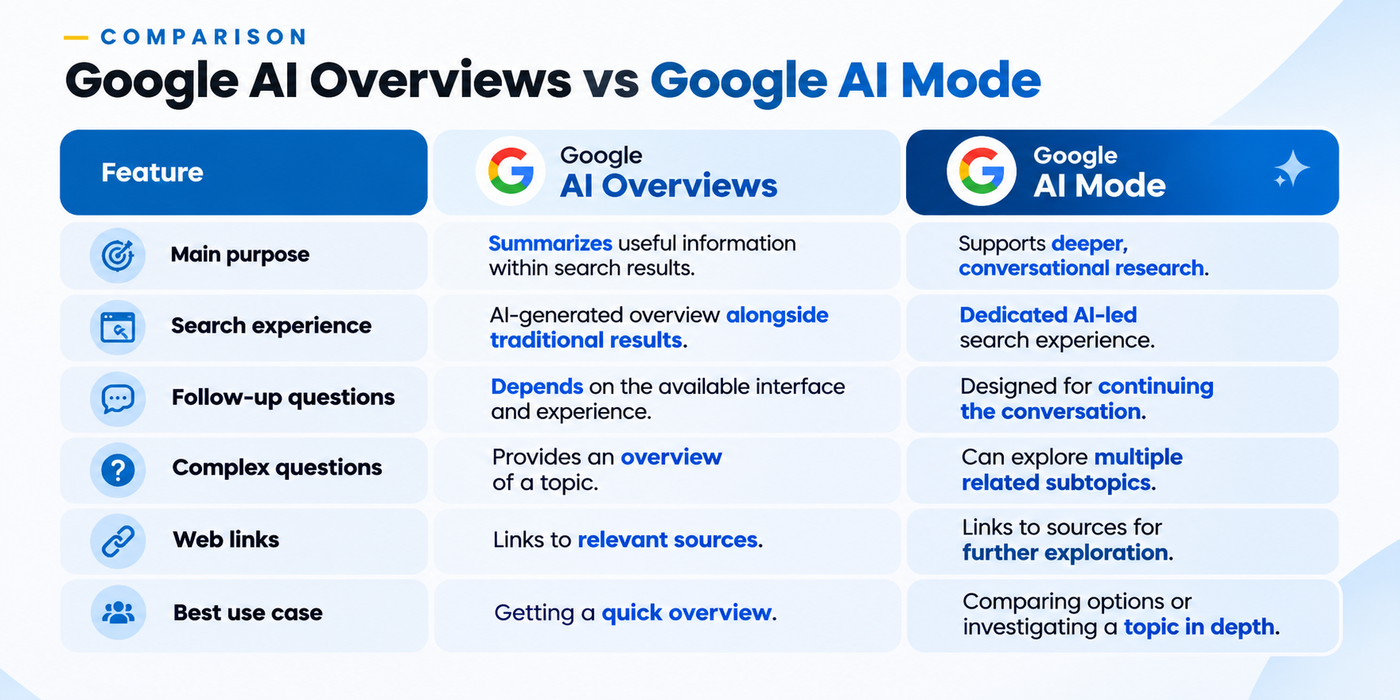
The key difference: AI Overviews generally provide an AI-generated summary within the search results page, while AI Mode is designed for a more interactive research experience.
The two experiences are related, and their capabilities can overlap. Neither should be treated as a replacement for every traditional search.
Why Does Google AI Mode Matter for SEO?
Google AI Mode matters because people can discover information through conversational questions and AI-generated responses, not only through traditional search result listings.
This creates opportunities and challenges for businesses that depend on organic search traffic.
1. Search Queries Can Become More Detailed
A user might previously search for "best website builder." In a conversational search experience, the same person might ask which platform is best for a local business with a limited budget, ecommerce requirements and no dedicated developer.
This makes it useful to understand the real questions your audience asks before making a decision.
Your content should address relevant problems, comparisons and practical considerations rather than simply repeating a target keyword.
2. Original Content Can Give People a Reason to Visit
If a page repeats information that is already widely available, it may provide little additional value to readers.
Original analysis, first-hand experience, meaningful examples, accurate data and clear explanations can make a page more useful.
For example, an article comparing website platforms can go beyond listing features by explaining how maintenance, customization and ongoing costs affect different types of businesses.
Google's guidance for website owners emphasizes useful, original content rather than pages created primarily to manipulate search visibility.
3. Website Visibility Is More Than Rankings Alone
A business may want to understand whether its content appears in AI-generated responses, whether users visit the website from those experiences and which pages attract meaningful engagement.
Traditional SEO metrics remain important, but AI-related visibility adds another dimension to search performance.
Google has introduced additional controls and reporting capabilities for generative AI search features. Availability and reporting details should be checked in the current Search Console documentation.
4. Being Mentioned Is Not the Same as Getting a Visit
A website may be referenced in an AI-generated response without the user clicking through.
For this reason, businesses should evaluate both visibility and outcomes. Relevant metrics may include organic clicks, impressions, engagement, enquiries and conversions.
A citation or mention can be useful for discovery, but it does not automatically translate into traffic or revenue.
How to Optimize Your Website for Google AI Mode
There is no separate checklist that guarantees inclusion in AI Mode. The most useful approach is to build on established SEO practices and make your content genuinely helpful for the questions your audience asks.
1. Answer the Main Question Clearly
Give readers a direct answer near the beginning of the page.
For an article about website maintenance, for example, explain what website maintenance includes before moving into detailed sections about security, updates, backups and performance.
A clear opening helps people understand the topic quickly and gives the rest of the article a useful structure.
2. Cover the Topic With Useful Depth
A page should answer the main question and address the related concerns that naturally follow from it.
For a guide about Google AI Mode, those concerns include how it works, how it differs from AI Overviews, what it means for SEO and how website owners can respond.
Depth does not mean making every article longer. It means providing enough relevant information to satisfy the reader's actual need.
3. Use Descriptive Headings and Logical Structure
Organize your content into sections that make sense independently and as part of the whole article.
Use descriptive headings, short paragraphs, relevant examples and comparison tables where they help readers understand the subject.
Avoid adding headings simply to repeat keywords. Each section should contribute useful information.
4. Add Original Examples and First-Hand Insights
Look for opportunities to explain something that a generic article would miss.
You might include a real workflow, an analysis of a website problem, a comparison based on practical requirements or original observations from your own work.
If you publish research or performance data, explain where it came from and how it was collected. Do not invent statistics or present assumptions as measured results.
5. Follow Technical SEO Best Practices
Search engines need to access and understand your website's content.
Check that important pages are crawlable, indexable and internally linked. Use descriptive page titles, accurate meta descriptions, canonical URLs where appropriate and mobile-friendly layouts.
Structured data can help search engines interpret supported information about a page, but it does not guarantee inclusion in AI-generated answers.
Technical SEO remains important; it is not a shortcut for getting cited by AI.
6. Use Internal Links to Connect Related Content
Internal links help readers move between related topics and help search engines understand the relationship between pages.
For example, an article about Google AI Mode could link to relevant Digivanta articles about SEO, website content or search updates.
Choose descriptive anchor text that tells readers what they will find on the destination page. Only link to pages that genuinely add value to the discussion.
7. Include Reliable Sources and Evidence
When discussing product features, search updates or technical recommendations, link to authoritative sources.
Official documentation is particularly useful for verifying how a platform works. For claims based on original research or business data, explain the source and relevant limitations.
Clear sourcing helps readers assess the information instead of relying on an unsupported claim.
8. Make Your Content Useful Beyond a Search Summary
Ask what a reader gains from visiting your page.
Could you provide a worked example, a meaningful comparison, original research, a practical explanation or a perspective grounded in experience?
The goal is not to write content that sounds like an AI response. It is to create a resource that is worth reading even when a search engine provides a quick summary.
AEO and GEO: Do They Matter for Google AI Mode?
AEO stands for Answer Engine Optimization, while GEO commonly stands for Generative Engine Optimization. These terms describe approaches to making information easier to find, understand and use in answer-based or generative search experiences.
They can be useful ways to think about content, but they should not be treated as separate ranking systems with guaranteed results.
For Google AI Mode, a practical approach includes:
- AEO: Answer common questions clearly, define important terms and structure explanations so readers can find the information they need.
- GEO: Add original insights, useful context, reliable evidence and relevant examples that make your content valuable in broader research.
- SEO: Maintain crawlable pages, relevant content, helpful internal links, clear page structure and a good user experience.
These approaches overlap. Strong SEO fundamentals and people-first content remain relevant to Google's generative AI search experiences.
Avoid claims that a particular word count, keyword density, schema type or special AI file guarantees visibility. Google does not promise that any single tactic will make a page appear in AI Mode.
Can You Track Google AI Mode Performance?
Website owners should use Google Search Console as a starting point for measuring search performance.
Google's documentation states that AI Mode activity is counted in the overall totals in the Search Console Performance report. This means those totals should not automatically be interpreted as traffic or impressions from traditional search listings alone.
Google also announced additional reporting insights and controls for generative AI search features in 2026. As of August 31, 2026, the announced generative AI search controls and insights had rolled out globally.
To monitor performance, review:
- Search impressions and clicks over time.
- Queries that bring users to relevant pages.
- Landing-page performance and changes in engagement.
- Enquiries, purchases or other meaningful conversions.
- Any AI-specific reporting available in your account.
Keep in mind that reporting capabilities can change. Check the current Search Console interface and Google's documentation before drawing conclusions about AI-specific traffic.
Most importantly, do not assume that a rise or fall in organic traffic was caused by AI Mode without supporting evidence.
Common Myths About Google AI Mode SEO
Myth 1: You Need a Separate AI SEO Strategy
Reality: You may need to adapt your content and measurement practices, but established SEO fundamentals remain relevant. Start with useful content, technical accessibility and a clear understanding of search intent.
Myth 2: Adding FAQ Schema Guarantees AI Visibility
Reality: Structured data does not guarantee that content will be cited in AI Mode. Use appropriate markup to describe supported page information accurately, not as a promise of enhanced AI visibility.
Myth 3: Longer Articles Always Perform Better
Reality: Length alone does not make content useful. A concise answer may be best for a straightforward question, while a complex topic may require a detailed explanation.
Myth 4: Publishing AI-Generated Content Guarantees Inclusion
Reality: The use of AI does not guarantee visibility. Google emphasizes helpful, reliable, people-first content and applies its spam policies to generative AI search experiences as well.
Myth 5: Every AI Mention Generates Website Traffic
Reality: Users can read an answer without visiting the source. Measure actual clicks, engagement and conversions rather than assuming every mention produces a visit.
Frequently Asked Questions
1. What is Google AI Mode in simple words?
Google AI Mode is a conversational search experience that uses AI to answer questions, investigate related topics and provide links to useful websites. Users can ask follow-up questions to explore a subject in greater depth.
2. How does Google AI Mode work?
It interprets a question, can search multiple related subtopics using query fan-out, gathers relevant web information and generates a conversational response with links to sources.
3. Is Google AI Mode the same as AI Overviews?
No. AI Overviews generally provide an AI-generated summary within search results. AI Mode offers a more interactive experience designed for deeper research and follow-up questions.
4. Is Google AI Mode available in India?
Google announced the rollout of AI Mode in India in 2025. The available experience and features may vary, so users should check Google Search or the Google app for current access.
5. Does Google AI Mode affect SEO?
It can influence how people discover information and interact with search results. Website owners should continue investing in useful content, technical SEO, clear site structure and meaningful performance measurement.
6. How can my website appear in Google AI Mode?
There is no guaranteed method. Make sure your important pages are accessible to Google, answer relevant questions clearly, provide original value and follow Google's search guidelines. Inclusion depends on Google's systems and the specific query.
7. Does Google AI Mode use websites to generate answers?
Google says AI Mode uses its understanding of web information to support responses. It can provide links to relevant websites so users can explore the original sources.
8. Can I track AI Mode traffic in Google Search Console?
AI Mode activity is included in the overall totals in the Search Console Performance report. Additional AI-specific reporting may be available depending on Google's current reporting features and rollout.
9. Do AEO and GEO replace traditional SEO?
No. AEO and GEO can help describe optimization for answer-based and generative search, but they do not replace the need for accessible pages, relevant content and established SEO best practices.
10. Should businesses change their content strategy for AI search?
Businesses should review whether their content answers real customer questions, offers original value and provides a useful experience. Adapt based on actual audience needs and performance data rather than following unverified AI optimization shortcuts.
Final Thoughts
Google AI Mode represents a shift toward search experiences where people can ask detailed questions, explore related topics and continue a conversation without repeatedly starting from scratch.
For businesses, the practical response is not to chase a secret AI ranking formula. It is to make their websites accessible, publish useful and original information, connect related content and measure how people discover and use that information.
SEO, AEO and GEO can work together as ways to think about discoverability, but none can guarantee an AI citation.
The strongest starting point is content that answers the question well and gives readers a genuine reason to visit the website.