Flipkart’s ‘Are You Really Gen Z?’ Campaign: Why Brands Are Rethinking Gen Z Marketing
 Sachin Gupta25 Sept 2026
Flipkart is turning a CAPTCHA into a Gen Z marketing challenge. Here’s a closer look at its “Are You Really Gen Z?” campaign, the creative idea behind it, and what it means for modern advertising.
Summarize this article with AI
What if a brand stopped trying to sound like Gen Z and instead asked Gen Z to prove that they are actually Gen Z?
That is the central idea behind Flipkart's latest campaign, “Are You Really Gen Z?”, launched for the upcoming Big Billion Days 2026 shopping festival.
Created by Flipkart in partnership with McCann India, the campaign takes something almost everyone on the internet knows a CAPTCHA and turns it into an interactive test of Gen Z culture, fashion, beauty and internet behaviour.
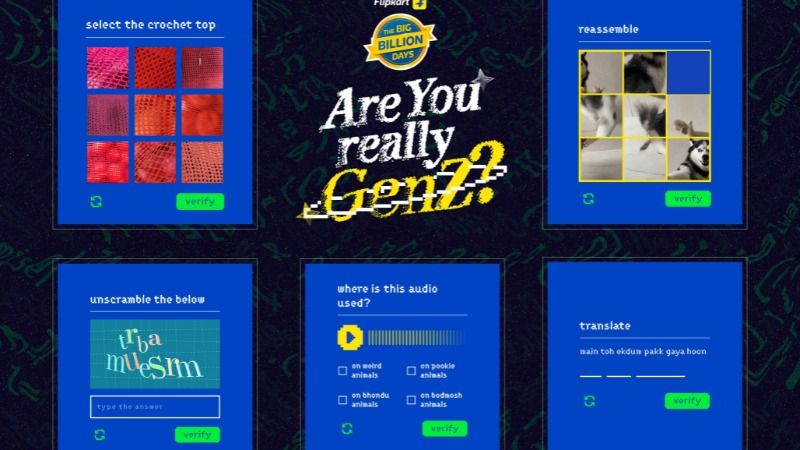
Users visiting AreYouReallyGenZ.com have to complete three Gen-Z-inspired CAPTCHA challenges. Those who clear the tests can unlock selected Big Billion Days offers focused on fashion and beauty.
At first, this looks like another campaign designed to attract younger shoppers before a major festive sale.
But there is more happening here.
Flipkart is not simply using Gen Z slang to sell products.
It is making fun of the way brands often try to use Gen Z language, memes and cultural references to appear relevant.
That makes the campaign interesting not only as a Flipkart advertising campaign, but also as a case study in Gen Z marketing, interactive advertising, consumer behaviour and creative campaign strategy.
And there is one question at the centre of it:
What happens when a brand knows that its audience knows it is trying to be relatable?
Flipkart's answer is: make that tension the campaign itself.
What Is Flipkart’s “Are You Really Gen Z?” Campaign?
Flipkart's “Are You Really Gen Z?” is a new Big Billion Days 2026 campaign developed with McCann India.
The campaign promotes Flipkart's Gen Z-oriented fashion and beauty offerings through a humorous cultural test.
Instead of simply showing products and discounts, the campaign asks users to prove whether they really understand Gen Z culture.
The campaign has three major components:
- A humorous campaign film
- A dedicated interactive website
- Gen Z-inspired CAPTCHA challenges that unlock selected offers
The campaign is currently live and is being amplified through digital and social media channels ahead of the Big Billion Days sale period. Campaign Brief Asia reports that the campaign will run through the Big Billion Days period, which begins on October 9, 2026.
Flipkart had separately announced its broader Big Billion Days 2026 campaign, “Luck Badal Sakta Hai, Yahan Kuch Bhi Ho Sakta Hai,” with early access beginning October 8 and the main event beginning October 9.
So “Are You Really Gen Z?” is best understood as a Gen Z-focused creative activation within the larger Big Billion Days marketing ecosystem.
What Is the Idea Behind “Are You Really Gen Z?”
The campaign starts with a very familiar advertising behaviour.
Brands want to connect with younger audiences.
To do that, they often borrow:
- Internet slang
- Memes
- Viral phrases
- Social media behaviour
- Gen Z fashion references
- Online humour
- Popular cultural cues
Words such as “rizz,” “cooked” and “no cap” have increasingly appeared in mainstream brand communication.
The problem is that language which feels natural inside a community can feel very different when a brand suddenly starts using it.
Flipkart's campaign takes that exact tension and turns it into humour.
The campaign film shows situations where people and businesses awkwardly force Gen Z slang into conversations where it does not naturally belong.
The Gen Z characters react with what the campaign wants viewers to recognise immediately:
cringe.
Instead of avoiding that awkwardness, Flipkart makes it the creative idea.
Why Is Flipkart Making Fun of Brands Using Gen Z Slang?
This is arguably the most interesting part of the campaign.
For several years, brands have tried to make their communication feel younger.
Sometimes the formula is simple:
Add slang + add meme reference + add casual tone = Gen Z campaign.
But Gen Z consumers are not simply a collection of words, memes or trends.
Culture is more complicated than vocabulary.
A brand can know what “rizz” means and still completely misunderstand the reason people use it.
That creates a gap between:
knowing the language
and
understanding the culture.
Flipkart's campaign plays directly with that gap.
Rather than pretending that brands naturally belong inside Gen Z culture, the campaign effectively says:
We know brands are trying to talk like you.
That self-awareness becomes part of the humour.
The campaign is therefore less about imitating Gen Z and more about observing how Gen Z sees brand behaviour.
What Is AreYouReallyGenZ.com?
AreYouReallyGenZ.com is the interactive website created as part of the campaign.
The site uses the familiar idea of a CAPTCHA but changes what the user has to prove.
Instead of asking users to identify traffic lights or buses, the experience tests their knowledge of:
- Gen Z culture
- Fashion
- Beauty
- Internet behaviour
Users have to clear three stages.
After completing the challenges, they can unlock selected Big Billion Days offers on Flipkart's fashion and beauty trends.
This is an important creative decision.
The CAPTCHA isn't just an extra feature added to the campaign.
The CAPTCHA is the campaign idea.
That is what makes the execution easier to remember.
Why Did Flipkart Use a CAPTCHA?
CAPTCHAs are one of those internet experiences that almost everyone recognises.
They usually exist to answer a simple question:
Are you human?
Flipkart changes that question into:
Are you really Gen Z?
That is a small creative transformation, but it gives the campaign a clear mechanism.
Instead of inventing an entirely new interaction, Flipkart takes an existing digital behaviour and gives it a cultural meaning.
This is often what makes an interactive campaign work.
The technology doesn't have to be complicated.
The idea behind the interaction has to make sense.
How Does the Flipkart Gen Z Campaign Work?
The campaign journey can be understood in five stages:
1. See the campaign
The audience encounters Flipkart's campaign film or social content.
2. Become curious
The unusual question—“Are You Really Gen Z?”—creates curiosity.
3. Visit the website
Users are directed to AreYouReallyGenZ.com.
4. Take the test
They complete three Gen-Z-inspired CAPTCHA challenges.
5. Unlock offers
Users who clear the tests can access selected Big Billion Days fashion and beauty offers.
So the campaign creates a simple journey:
Awareness → Curiosity → Interaction → Participation → Commerce
That is much more interesting than:
Advertisement → Product page
Why Interactive Advertising Is Becoming More Interesting
Traditional advertising often asks the audience to watch.
Interactive advertising asks the audience to participate.
That difference matters.
Imagine two advertisements.
Traditional experience
You see a 30-second video.
You understand the offer.
You scroll away.
Interactive experience
You see a campaign.
You click.
You take a test.
You laugh at a question.
You try to clear the next stage.
You unlock something.
The second experience gives the audience something to do, not just something to watch.
That doesn't automatically mean every interactive campaign will perform better.
Actual business performance depends on factors such as reach, audience fit, creative execution, conversion, offer attractiveness and campaign distribution.
But interaction can give a campaign additional opportunities to create attention and participation.
Flipkart has built that participation directly into its Gen Z campaign.
Flipkart Is Turning an Advertisement Into an Experience
This is one of the bigger marketing ideas behind the campaign.
The campaign doesn't stop with the film.
The user can move from:
Video → Website → CAPTCHA → Offer
The website is therefore not just a landing page.
It becomes part of the advertising experience.
This is increasingly important in digital marketing.
A landing page can be:
- A destination
- A product catalogue
- A calculator
- A quiz
- A game
- A personalised experience
- A content experience
- Or part of the creative itself
Flipkart's campaign uses the website as the last option.
What Makes This Flipkart Campaign Different From a Typical Gen Z Campaign?
A typical Gen Z advertising campaign might focus heavily on:
- Trendy music
- Slang
- Fast editing
- Memes
- Influencers
- Casual copy
- Social-first visuals
Flipkart uses some of the cultural language but approaches the problem differently.
It asks:
Why are brands using this language in the first place?
Then it turns that observation into the campaign.
That makes the campaign somewhat self-referential.
The brand is advertising to Gen Z while simultaneously talking about how brands advertise to Gen Z.
That second layer is what gives the campaign its humour.
The Campaign's Most Important Marketing Insight
The biggest lesson isn't:
“Use Gen Z slang.”
In fact, the campaign suggests almost the opposite.
The bigger lesson is:
Don't confuse cultural vocabulary with cultural understanding.
If a brand wants to connect with Gen Z, simply learning the latest internet phrase is not enough.
A stronger approach is to understand:
- What the audience finds funny
- What they find forced
- What they ignore
- What they share
- What they consider authentic
- How they interact with brands
- How quickly trends change
- Which cultural references actually matter
Flipkart's campaign is built around one such observation: audiences can recognise when brands are trying too hard to sound like them.
Why “Cringe” Became Part of the Strategy
“Cringe” is important to the campaign because it creates a shared cultural reaction.
The campaign film shows situations where Gen Z language is used awkwardly.
The humour comes from the gap between:
what the speaker thinks sounds cool
and
how the audience actually receives it.
That gap is familiar to anyone who has watched a brand jump onto a trend several weeks after it peaked.
Instead of avoiding that awkwardness, Flipkart uses it.
The campaign effectively turns:
“Brands are trying too hard.”
into:
“Let's make a campaign about brands trying too hard.”
That is a much clearer creative idea.
Is Flipkart Trying to Be Gen Z?
Not exactly.
And that distinction is important.
Flipkart isn't simply saying:
“We are Gen Z too.”
Instead, the campaign says:
“We understand the way Gen Z reacts when brands try too hard to be Gen Z.”
That creates some distance between the brand and the behaviour it is making fun of.
The campaign therefore uses self-awareness instead of imitation.
Whether individual Gen Z consumers actually find the campaign relatable cannot be established from the campaign alone. Gen Z is not a single homogeneous audience, and reactions can differ by person, region, interest and cultural context.
But the campaign clearly chooses one interpretation of Gen Z behaviour and builds the creative around it.
What Products Is the Campaign Promoting?
The interactive experience focuses on fashion and beauty trends aimed at Gen Z shoppers during Big Billion Days.
Rather than placing the products at the centre of the campaign from the beginning, Flipkart makes the cultural test the entry point.
This changes the order of the experience.
Instead of:
Product → Discount → Purchase
the campaign uses:
Culture → Curiosity → Game → Offer → Shopping
That makes the promotional element feel integrated into the campaign concept.
Why This Matters During Big Billion Days
Big Billion Days is one of Flipkart's biggest annual shopping events.
Flipkart announced that Big Billion Days 2026 will have early access on October 8, with the main event beginning October 9.
A major sale also means a crowded advertising environment.
Consumers will encounter:
- Price discounts
- Product launches
- Influencer campaigns
- Celebrity advertising
- App notifications
- Brand partnerships
- Social media promotions
- Countdown campaigns
In such an environment, saying:
“Big sale coming soon”
is unlikely to be enough to create a distinctive creative identity on its own.
Flipkart's Gen Z campaign gives the shopping event another conversation:
Are you actually Gen Z?
That creates a cultural hook before the consumer even starts thinking about products.
The Difference Between a Sale Campaign and a Culture Campaign
A sale campaign usually focuses on:
Price → Product → Urgency
A culture-led campaign can focus on:
Identity → Behaviour → Participation → Product
Flipkart combines both.
The cultural test attracts attention.
The fashion and beauty offers provide the commercial reason.
This combination gives the campaign two layers:
Emotional layer
“Do you understand Gen Z culture?”
Commercial layer
“Here's what you can unlock during Big Billion Days.”
That is a useful structure for a large ecommerce campaign.
What Can Other Brands Learn From Flipkart's Gen Z Campaign?
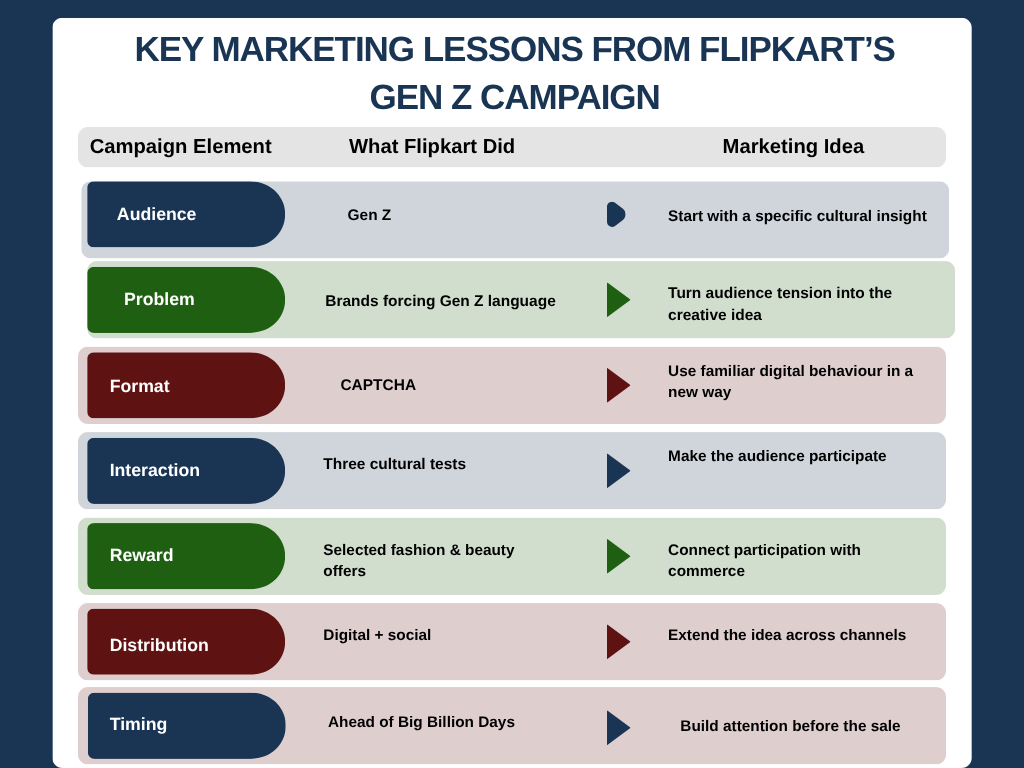
1. Don't start with the product
The campaign doesn't begin by saying:
“Here are our fashion products.”
It begins with a question.
That question creates curiosity before the product appears.
For many brands, this can be a useful creative principle.
Instead of asking:
What product should we advertise?
ask:
What behaviour or tension around this product can become the idea?
2. Find the audience's real behaviour
Flipkart identified a specific behaviour:
Brands trying to speak like Gen Z.
Then it turned that behaviour into creative territory.
Other brands can do the same.
For example:
A food delivery brand could look at how people decide what to order at midnight.
A beauty brand could explore how customers save 20 products before buying one.
A travel brand could explore how people plan trips through Instagram reels.
A fintech brand could look at how young users actually talk about money.
The behaviour becomes the starting point.
3. Don't force trends into the campaign
A trend isn't automatically an idea.
A meme isn't automatically a strategy.
A viral word isn't automatically good copy.
The strongest campaigns often ask:
Why does this trend matter to the audience?
rather than:
How quickly can we use it?
Flipkart's campaign demonstrates that distinction.
4. Turn familiar technology into something unexpected
CAPTCHA technology is not new.
But using it as a cultural test is unexpected.
This is a useful creative approach:
Take something familiar → change its purpose → create a new experience.
Brands don't always need to invent new technology.
Sometimes they need to give existing behaviour a new meaning.
5. Give people a reason to participate
The audience has to do something.
In this campaign:
Complete the test → unlock the offer.
The interaction has a clear reward.
That keeps the campaign from becoming an empty gimmick.
What This Campaign Says About Gen Z Marketing in India
The broader story is that Gen Z marketing is becoming less about looking young and more about understanding how younger audiences behave.
That's an important distinction.
A brand can use:
- bright colours
- slang
- memes
- creators
- short videos
and still feel completely disconnected.
Meanwhile, a simple idea based on a real consumer behaviour can feel much more relevant.
Flipkart's campaign is an example of the second approach.
It doesn't try to prove that Flipkart is Gen Z.
It creates an experience based on how Gen Z might view brands trying to imitate them.
Gen Z Marketing Is Not Just About Gen Z
There is another interesting point here.
The campaign may attract Gen Z because the cultural references are relevant to them.
But the idea can also attract older audiences because they recognise the behaviour of brands trying to use internet language.
Someone doesn't necessarily need to be Gen Z to understand the joke.
That makes the creative idea broader than the audience label.
This is often useful in mass-market advertising.
A campaign may be built around a specific audience without being understandable only to that audience.
Why Humour Works in This Campaign
Humour gives Flipkart an easier way to address a potentially uncomfortable subject.
Imagine Flipkart saying:
“Brands should stop using Gen Z slang incorrectly.”
That would sound like a lecture.
Instead, the campaign shows awkward examples.
The audience can recognise the situation themselves.
That's the difference between telling people an insight and letting people experience the insight.
The latter can make the message more entertaining.
Is “Are You Really Gen Z?” a Good Marketing Strategy?
There is no public campaign-performance data yet that would justify declaring it commercially successful or unsuccessful.
What can be evaluated from the public campaign itself is the creative structure.
The campaign has:
- A clear cultural tension
- A memorable question
- A recognisable digital mechanism
- An interactive website
- A connection to fashion and beauty
- A direct link to Big Billion Days offers
- Social and digital amplification
Those elements make the campaign easy to understand as a connected marketing idea.
Whether that translates into stronger sales, engagement or brand metrics would require actual campaign data.
How the Flipkart Campaign Connects Creativity and Commerce
One of the strongest aspects of the campaign is that the creative idea isn't disconnected from the commercial objective.
The cultural test eventually leads to shopping offers.
That means the journey has a logical structure:
Attention
↓
Curiosity
↓
Interaction
↓
Qualification
↓
Offer
↓
Shopping
The user doesn't just see a funny campaign.
There is a path from the creative idea to the commercial experience.
What Other Ecommerce Brands Could Learn
Ecommerce brands frequently compete around:
- Discounts
- Delivery
- Product selection
- Price
- Cashback
- Sale dates
But when every platform communicates similar benefits, creative differentiation becomes harder.
Flipkart's campaign shows another possibility:
Own a cultural conversation before asking people to shop.
The product doesn't disappear.
It simply enters later.
That can give the brand more room to build attention before making the commercial message.
What This Means for Digital Marketers
For digital marketers, the campaign offers an important reminder.
Marketing isn't always about producing more content.
It is about finding the idea that makes the content worth noticing.
A brand can publish:
- 10 Instagram posts
- 5 reels
- 3 ads
- 2 blogs
- 1 influencer campaign
and still struggle to stand out.
Another brand can build one strong idea and distribute it across:
Film + Website + Social + Interactive Experience + Offer
The second approach can create a stronger connection between individual campaign assets.
Flipkart's campaign is an example of this integrated approach.
From “Content” to “Participation”
There is a larger shift happening in digital marketing.
Brands increasingly want users to do more than consume content.
They want them to:
- Comment
- Vote
- Play
- Test
- Share
- Create
- Personalise
- Unlock
- Participate
The Flipkart Gen Z campaign fits into this broader movement.
The user isn't just a viewer.
They become a participant in the campaign.
What Does the Flipkart Campaign Tell Us About the Future of Advertising?
One possible direction is that advertising will increasingly combine:
Content + Experience + Technology + Commerce
Instead of separate steps:
Advertisement
then
Website
then
Product page
the experience can become one connected journey.
Flipkart's campaign demonstrates a relatively simple version of this:
Ad → interactive test → offer
The technology itself isn't the main attraction.
The creative idea determines why the technology is being used.
That's an important distinction.
The Bigger Lesson: Don't Try Too Hard to Be Relatable
Perhaps the most useful takeaway from Flipkart's campaign is also the simplest.
Consumers can tell when a brand is trying too hard.
This doesn't mean brands should avoid cultural conversations.
It means brands need to understand the difference between:
participating in culture
and
copying culture.
The first requires observation.
The second often requires only imitation.
Flipkart's campaign turns that distinction into the joke.
And that's why the campaign has more to discuss than just its catchy title.
Frequently Asked Questions About Flipkart's “Are You Really Gen Z?” Campaign
What is Flipkart's “Are You Really Gen Z?” campaign?
Flipkart's “Are You Really Gen Z?” is a Big Billion Days 2026 campaign created with McCann India. It uses humour, Gen Z culture and interactive CAPTCHA-style challenges to promote selected fashion and beauty offers.
Who created the Flipkart Gen Z campaign?
The campaign was created by McCann India in partnership with Flipkart. Campaign coverage identifies McCann India as the agency behind the campaign.
What is AreYouReallyGenZ.com?
AreYouReallyGenZ.com is the interactive website created for the campaign. Users complete three Gen-Z-inspired CAPTCHA challenges covering areas such as culture, fashion, beauty and internet behaviour. Users who clear the challenges can unlock selected Big Billion Days offers.
Why is Flipkart using a CAPTCHA in its campaign?
Flipkart uses the familiar CAPTCHA format as a creative device. Instead of proving that the visitor is human, the campaign asks users to prove their familiarity with Gen Z culture.
What does the Flipkart campaign have to do with Big Billion Days?
The campaign is part of Flipkart's promotional activity around Big Billion Days 2026 and specifically connects users to fashion and beauty offers. The main Big Billion Days event begins October 9, 2026, with early access beginning October 8.
Why is Flipkart targeting Gen Z?
Gen Z represents an important consumer audience for fashion, beauty, digital commerce and social media. Flipkart's campaign specifically uses Gen Z cultural references and offers around fashion and beauty to build engagement before Big Billion Days.
Is Flipkart's campaign only for Gen Z?
The campaign is designed around Gen Z culture, but the humour and interactive format can be understood by a broader audience. Whether an individual user considers themselves Gen Z is part of the campaign's playful premise.
What can marketers learn from Flipkart's Gen Z campaign?
The campaign demonstrates the value of starting with a real audience behaviour rather than simply copying popular language. It also shows how an interactive experience can connect advertising, engagement and commerce.
Is Flipkart's Gen Z campaign a successful campaign?
There is not enough publicly available performance data yet to determine its commercial success. The campaign can be analysed for its creative concept, interactive execution and connection to Big Billion Days, but sales or ROI conclusions would require verified campaign-performance data.
What is the idea behind Flipkart's Gen Z campaign?
Flipkart's “Are You Really Gen Z?” campaign turns the way brands try to imitate Gen Z culture into the central creative idea. Instead of simply using Gen Z slang, Flipkart uses humour and CAPTCHA-style challenges to test users on culture, fashion, beauty and internet behaviour before unlocking selected offers.
How does Flipkart's “Are You Really Gen Z?” campaign work?
Users visit the campaign website, complete three Gen-Z-inspired CAPTCHA challenges and, after clearing them, can unlock selected Big Billion Days fashion and beauty offers.
When does Flipkart Big Billion Days 2026 start?
Flipkart's official announcement says early access begins on October 8, 2026, while the main Big Billion Days event begins on October 9, 2026.