
Facebook Reels-First Experience in India: Meta's 2026 Test Explained
 Sachin Gupta7 Oct 2026
Meta is testing a Reels-first Facebook experience in India. Learn how it works, why Meta is testing it, and what it means for users, creators and brands.
Summarize this article with AI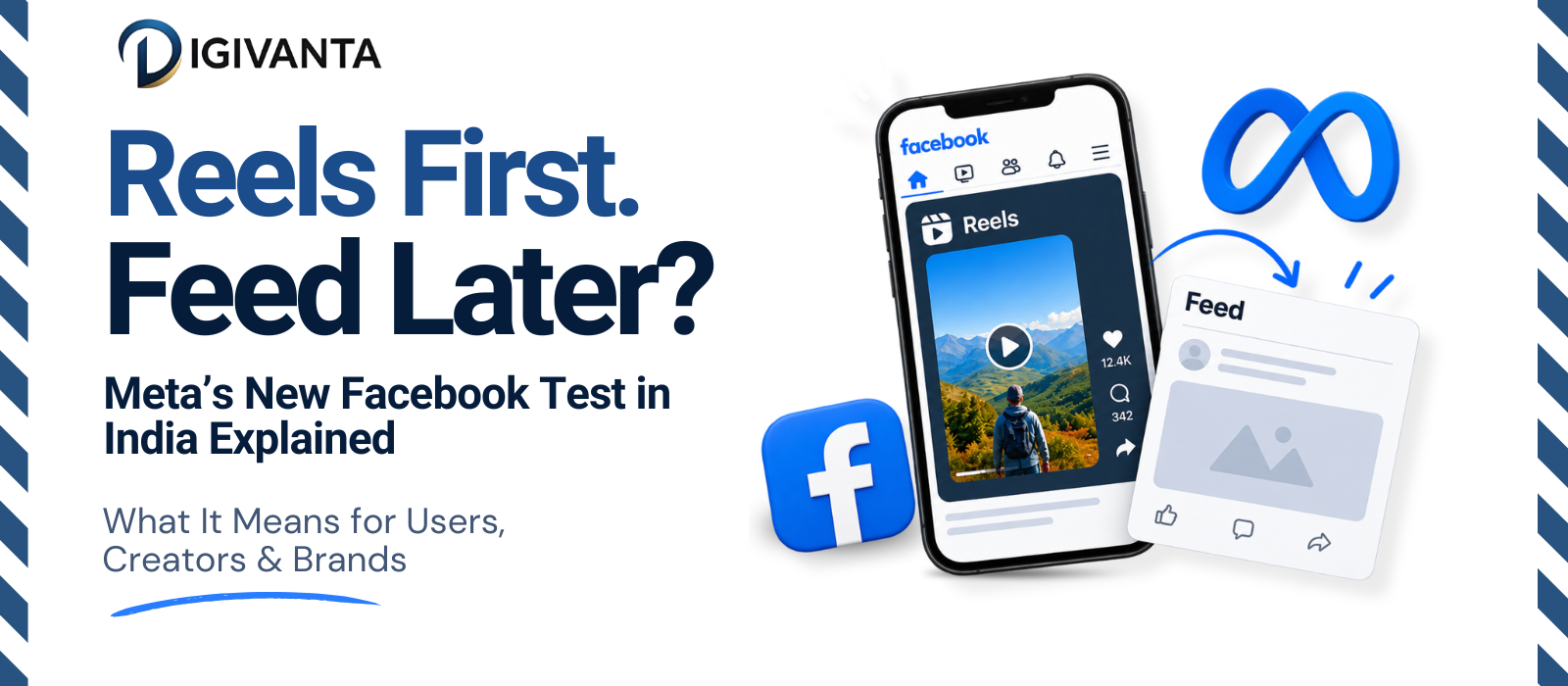
Facebook may be changing the first thing you see when you open the app.
Meta is currently testing a Reels-first experience on Facebook in India, where selected users are taken directly into a full-screen video experience instead of opening on the traditional Feed. The Classic Feed is still available as a separate tab, and users included in the experiment can switch back to the Feed-first experience.
That means Facebook is not disappearing, and the traditional Feed is not being removed.
But the starting point is changing.
And that small interface change could have a much bigger impact on how people discover content, how creators make videos and how brands think about Facebook.
This is especially interesting in India because Meta has been seeing extremely strong video consumption across the country. In research released by Meta in June 2026, 97% of surveyed users said they watch video on Meta platforms at least once a day, while 89% of surveyed Gen Z users said they engage with Reels daily.
So what exactly is Meta testing? Why India? How will it work? And what could change for Facebook users, creators and businesses?
Let's break it down.
What Is Meta's Reels-First Facebook Experience?
The easiest way to understand the update is this:
Old Facebook experience:You open Facebook → traditional Feed appears → you scroll through posts → you may eventually watch a Reel.
New Reels-first test:You open Facebook → full-screen video/Reels appear first → you start watching → you can continue discovering videos → Classic Feed remains available separately.
The test is currently being shown to some Facebook users in India rather than everyone. According to reports, Meta is using the experiment to test a more immersive, video-forward Facebook experience.
This distinction is important because this is not a completely new Facebook app.
It is a change to the entry experience inside the existing Facebook app.
Meta has also been moving Facebook toward a more unified video experience. In 2025, the company announced that new videos posted to Facebook would be shared as Reels, regardless of their length or format, and the former Video tab was renamed the Reels tab. The latest test takes that direction one step further:
Instead of simply making more videos Reels, Meta is testing whether Reels should be the first thing people see.
How Will the Reels-First Facebook Experience Work?
The experience is relatively simple from the user's point of view.
If Meta includes your account in the test, opening Facebook may take you directly into a full-screen video feed.
Instead of seeing a mixture of text posts, photos, links and updates first, you'll immediately see video content.
From there, the experience is designed around continuous discovery.
You watch one Reel.
Then another.
The recommendation system determines what appears next based on signals it has about your interests and behaviour.
Meta has already been improving Facebook's recommendations engine. The company said in 2025 that it had upgraded its recommendation system to understand users' interests faster and surface newer, more relevant Reels. It also introduced stronger personalization signals, including “Not Interested” feedback. So the Reels-first test is not simply about changing the homepage.
It is also about putting Facebook's recommendation system closer to the front door of the app.
The Classic Feed does not disappear. It remains accessible as another tab, and users included in the test can opt out and return to the traditional Feed-first experience.
Why Is Meta Testing Reels-First on Facebook?
There are several reasons behind this change, but the biggest one is how people consume content.
People don't necessarily open social media knowing exactly what they want to watch.
Often, they open the app first and decide what interests them based on what appears on screen.
Short-form video fits that behaviour extremely well.
Meta's 2026 India research shows just how significant video has become. The company reported that 97% of surveyed Indian users watch video on its platforms daily, with daily engagement at 98% among surveyed urban users and 94% among surveyed rural users.
That tells Meta something important.
Video isn't restricted to a small group of young urban users.
It has become a much broader consumption behaviour.
Meta also reported that 89% of surveyed Gen Z users engage with Reels daily, while Reels was associated with strong discovery and purchasing influence in the company's commissioned research.
So the Reels-first experiment can be understood as Meta asking a straightforward product question:
What happens if Facebook starts with the type of content many users already spend time watching?
Why Is Meta Testing This in India?
India is particularly important to this experiment.
According to TechCrunch, India is Facebook's largest market by users, with Meta's advertising tools indicating an audience of more than 400 million people in the country.
India is also a market where Meta has already experimented heavily with short-form video.
Instagram began testing a dedicated Reels experience in India in 2020, following the country's TikTok ban. Meta later tested Reels-first experiences on Instagram for some users in India and South Korea.
Now Facebook is doing a similar experiment.
That makes India more than just the location of another interface test.
It is a market where Meta can observe what happens when a very large and diverse audience encounters a video-first social experience.
What Will Change for Facebook Users?
For ordinary users, the biggest change could simply be what Facebook puts in front of them first.
If the test becomes more widely available, opening Facebook could feel less like opening a traditional social network and more like opening a personalized video discovery platform.
Instead of asking:
“What did my friends post?”
the experience starts with:
“Here's a video Facebook thinks you'll watch.”
That is a meaningful change in user behaviour.
However, users who prefer the traditional Feed are not necessarily being forced into the new experience. Meta's current test allows users to return to the Feed-first experience, while Classic Feed remains available separately.
So at this stage, the experience is better understood as personalized entry points, not the complete replacement of Facebook's Feed.
Will Facebook Remove the Traditional Feed?
Not according to the current test.
The Classic Feed remains available as a separate tab.
The Reels-first experience is being tested as another way to start using Facebook, and users in the experiment can switch back to Feed-first.
This is important because Facebook serves very different purposes for different people.
One person may use Facebook mainly for family and friends.
Others may use Groups.
Someone else may use the Marketplace.
A creator may use it for video distribution.
A business may use it for customers and communities.
Meta therefore has a reason to experiment with different entry experiences instead of completely removing the traditional Feed.
What Does This Mean for Facebook Creators?
This could be one of the biggest implications of the change.
If more users enter Facebook through full-screen video, video becomes closer to the centre of the Facebook experience.
Creators could therefore have more opportunities to reach people who don't already follow them.
Why?
Because recommendation-driven video does not depend entirely on an existing follower relationship.
A user doesn't necessarily need to follow a creator before Facebook can recommend that creator's Reel.
Meta has already said that its recommendation system is designed to surface content based on users' interests, including newer Reels and content from creators.
This changes the creator's challenge.
It is no longer only:
“How do I get my followers to see this?”
It becomes:
“Can this video make sense to someone who has never seen me before?”
That makes the opening, storytelling, topic relevance and watchability of a Reel increasingly important.
But there is no guarantee that every creator will automatically receive more reach because of this test.
The experience is still experimental, and Meta has not announced that Reels-first will become the permanent Facebook experience for everyone.
What Does This Mean for Brands?
For brands, the change could influence how discovery begins.
A traditional customer journey might look like:
Need → Search → Website → Product
But social video can create a different journey:
Video → Interest → Profile → Search → Website → Purchase
Someone may not be looking for a skincare brand, restaurant, clothing company or digital agency when they open Facebook.
They may simply be watching videos.
Then a Reel catches their attention.
They visit the profile.
They search for the company.
They read reviews.
They visit the website.
The purchase decision happens later.
Meta's 2026 India research reported that Reels was associated with 81% stronger product discovery and 47% greater influence on purchase decisions compared with other surveyed short-form video platforms in its studies. These figures come from Meta-commissioned research, so they should be treated as platform-reported findings rather than independent industry measurements.
The important idea is not the number alone.
It is the role of video in discovery.
Do Reels-First Mean Brands Should Stop Posting Images?
No.
That would be an overreaction.
Meta is testing a Reels-first opening experience. It has not announced that Facebook will stop supporting other types of content. The Classic Feed remains part of the experience.
Different formats still serve different purposes.
A Reel can attract attention.
A carousel can explain.
A photo can communicate something quickly.
A text post can start a discussion.
A Group can build community.
The more useful question for brands is not:
“Should everything become a Reel?”
It is:
“Which part of the customer journey does each format help with?”
That is a much more sustainable content strategy.
Will Facebook's Algorithm Change Because of Reels-First?
The interface change does not necessarily mean Facebook is introducing an entirely new algorithm.
In fact, Meta has already been using recommendation systems to personalize the Reels experience.
In 2025, Meta said its recommendation engine was upgraded to understand interests faster, show newer and more relevant Reels, and respond to signals such as users selecting “Not Interested.”
The Reels-first test therefore gives that recommendation system more importance at the moment the user opens Facebook.
That could increase the importance of signals that help Meta understand what a person wants to watch.
But marketers should avoid assuming that Meta has published a new ranking formula specifically for this October 2026 test.
It hasn't.
So claims such as “this exact hook will now rank your Reel” or “Facebook is changing its algorithm to X” would go beyond the available evidence.
What Could Change for Facebook Advertising?
The Reels-first experience could make the Reels environment even more important for advertisers because users would encounter video earlier in their Facebook session.
Meta already supports Reels ads as immersive, mobile-first placements, and its advertising documentation emphasizes vertical video, audio and creative design for the Reels environment.
But again, the current Facebook Reels-first test does not mean advertisers automatically receive more Reels ad inventory or guaranteed better performance.
That distinction matters.
The potential impact is more strategic:
If more user attention moves toward Reels, brands may need to think more seriously about creative designed for a video-first environment.
That means the creative itself becomes increasingly important.
Not just the targeting.
Not just the budget.
The content has to earn attention.
Is Facebook Becoming TikTok?
It is tempting to say yes.
But that would be too simplistic.
Facebook is adopting a video-first consumption pattern, but Facebook remains a much broader platform.
It still includes the Feed, Groups, Marketplace, Pages, communities, messaging and other experiences.
The more accurate way to look at the update is:
Facebook is borrowing the discovery behaviour that made short-form video platforms so powerful.
The user doesn't always have to know what they want.
The platform can recommend it.
Meta has already been moving Facebook's video experience in this direction, including a unified fullscreen video player and more personalized video recommendations.
The Reels-first experiment simply moves that experience closer to the beginning of the Facebook journey.
What Does This Mean for Social Media Marketing in 2026?
The bigger story is not just Facebook.
It is the shift from feed-based discovery to recommendation-based discovery.
Traditional social media was heavily dependent on relationships:
Who do you follow?
Which Page do you like?
Which Group are you in?
But recommendation systems allow platforms to answer a different question:
What should this person see next?
That creates opportunities for creators and brands that don't already have huge audiences.
A person who has never heard of a brand can encounter it through a video.
A creator with a smaller following can potentially reach people outside their existing audience.
A niche topic can find its audience without the user actively searching for it.
That is why this Facebook update is worth watching.
It is not simply a UI redesign.
It is another sign that discovery itself is becoming algorithmically mediated.
What Should Brands Do Differently?
The answer isn't “post more Reels.”
It is more specific.
Brands should start thinking about whether their content works when it is shown to someone who has no prior relationship with the brand.
A follower already knows who you are.
A recommendation-feed viewer doesn't.
That means the content needs to establish context quickly.
Instead of assuming:
“Our audience already understands us.”
Think:
“What would make a stranger stop and care?”
This is especially relevant for brands using Facebook for discovery rather than only community management.
The Reels-first test could make that difference even more important if the experience expands.
What Happens Next?
For now, Meta is testing.
Some users in India are seeing the Reels-first experience, while others continue to open Facebook through the traditional Feed. The company has said users in the test can switch back, and the Classic Feed remains available as a separate tab.
Meta has also previously indicated that it was interested in testing the video-first experience internationally before potentially exploring a U.S. rollout.
So the next things worth watching are:
- Whether Meta expands the test to more Indian users
- Whether the Reels-first experience becomes permanent
- Whether the experience reaches additional countries
- How users respond to the new opening screen
- Whether creators change how they publish on Facebook
- Whether brands increase their focus on Facebook Reels
- Whether Meta makes further changes to Facebook's recommendation system
Until Meta confirms a wider rollout, however, it is better to call this a test, not a permanent Facebook redesign.
Frequently Asked Questions
What is Facebook's Reels-first experience in India?
It is a Facebook test in which selected users in India open the app directly into a full-screen video/Reels experience instead of the traditional Feed. The Classic Feed remains available separately.
Is Meta launching a new Reels-first Facebook app?
No. The current report is about a Reels-first experience inside the existing Facebook app, not a separate Facebook application.
Will Facebook remove the News Feed?
There is no indication that Meta is removing the traditional Feed as part of this test. Classic Feed remains available as a separate tab, and users included in the experiment can switch back.
Why is Meta testing Reels-first in India?
India is a major market for Facebook and has very high video consumption. Meta's 2026 research reported that 97% of surveyed Indian users watch video on its platforms daily and that 89% of surveyed Gen Z users engage with Reels daily.
How does the Reels-first Facebook experience work?
For users included in the test, Facebook opens directly into a full-screen video experience. Reels are recommended based on the platform's personalization and recommendation systems. Users can still access the traditional Feed separately.
Will Reels get more important for Facebook creators?
Potentially, because Reels would become the first content users see in the test experience. However, Meta has not promised additional reach for creators, and the test does not guarantee that every Reel will perform better.
Will brands need to post more Reels?
Not necessarily. The better approach is to understand what role video plays in discovery and create content that works for people who may not already know the brand.
Is Facebook becoming like TikTok?
Facebook is adopting a more recommendation-led, video-first experience, but it still retains its broader ecosystem of Feed, Groups, Marketplace, Pages and communities. Calling it a TikTok replacement would oversimplify the change.
Does Reels-first mean Facebook's algorithm has completely changed?
No such complete algorithm change has been announced. Meta has already been improving its Reels recommendation system, including personalization and newer-content recommendations. The current test changes the entry experience, not necessarily the entire ranking system.
Can users switch back to the normal Facebook Feed?
According to current reports, users included in the test can opt out and return to a Feed-first experience. The Classic Feed also remains accessible as a separate tab.
Final Takeaway
Meta's Reels-first Facebook experiment in India may look like a small interface change.
It isn't.
The interesting part is what the change says about how social platforms are evolving.
Facebook was originally built around a feed of things connected to people and pages you followed.
Now Meta is testing an experience where the first thing you see can be something its recommendation system thinks you will watch.
That's a shift from “Who do you follow?” toward “What do you want to watch next?”
And that matters for everyone.
For users, it changes how Facebook begins.
For creators, it could make video discovery even more important.
For brands, it reinforces the role of short-form video in discovery.
For marketers, it is another reminder that attention is increasingly being distributed by recommendation systems rather than only by follower relationships.
For now, it remains a test.
But if Meta eventually makes Reels the default entry point for a larger part of Facebook, the way brands create content for Facebook may have to change with it.